Travelling from London to Paris by coach
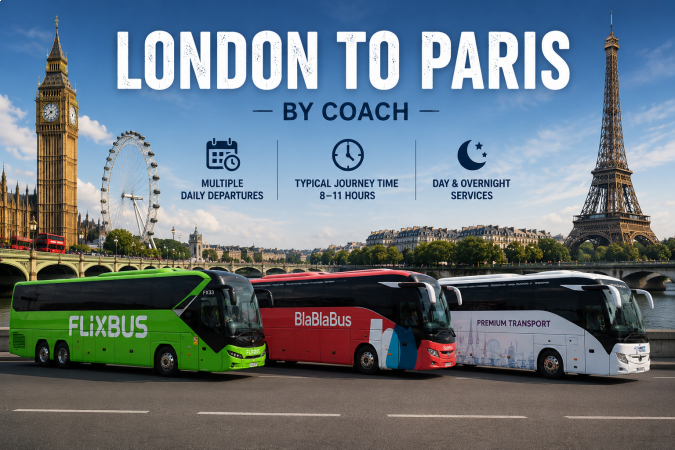
Coach travel between London and Paris remains one of the most interesting and underestimated international transport corridors in Europe. Although Eurostar dominates the fastest city-centre journeys between Britain and France, direct long-distance coaches continue to provide an important alternative for passengers looking for lower fares, larger luggage allowances, overnight travel options and wider operational flexibility. Today’s London–Paris coach market is very different from the old Eurolines era. Modern services are now operated through a mixture of European network platforms, direct coach corridors, dynamic timetables, cross-Channel ferry and Eurotunnel operations, and integrated booking systems. At the same time, many of the operational realities of long-distance coach travel remain unchanged. Passengers still experience passport checks, overnight motorway travel, Channel crossings, scheduled rest stops, driver changes and long-distance international transport in its most traditional form. For many travellers, this is not simply the cheapest way to reach Paris. It is also one of the most practical and operationally flexible ways to travel directly from London to Paris by bus or coach.
Quick navigation
- Book London to Paris coach tickets
- Why people still travel by coach
- Main direct operators
- London Victoria Coach Station
- How direct is a direct coach?
- Ferry crossings and Eurotunnel
- Brexit and border controls
- Paris Bercy Seine coach station
- Typical journey times
- Day coach or overnight coach?
- Baggage policies
- What to keep in hand luggage
- Why coach still survives despite Eurostar
- FAQ
- Final thoughts
Book London to Paris coach tickets
Use the links below to compare direct London to Paris coach services. The main operators and booking options are FlixBus, BlaBlaCar Bus and TopBus. BlaBlaCar Bus and TopBus may also be checked through Infobus as a booking agent.
FlixBusUseful for direct London–Paris coach services, overnight departures and integrated bookings from selected UK regional cities. |
BlaBlaCar Bus & TopBusCheck BlaBlaCar Bus and TopBus options through Infobus. Infobus acts as a booking agent and may show additional London–Paris coach services. |
Tip: Before booking, check the exact London departure point, Paris arrival stop, baggage allowance, crossing method and whether the journey is daytime or overnight.
Why people still travel from London to Paris by coach
Although coaches are slower than Eurostar and airlines, they continue to offer several important advantages:
- lower fares,
- larger baggage allowances,
- fewer luggage restrictions,
- overnight travel possibilities,
- direct access from London Victoria Coach Station,
- and easier onward travel beyond Paris.
Coach travel also remains attractive for students, long-term travellers, passengers carrying larger luggage, budget-conscious travellers and people connecting from regional UK cities. One particularly important operational advantage is flexibility. Unlike rail services tied to fixed infrastructure, coach operators can adapt routes, stops and operational patterns depending on traffic, border conditions and demand.
Main direct operators between London and Paris
FlixBus
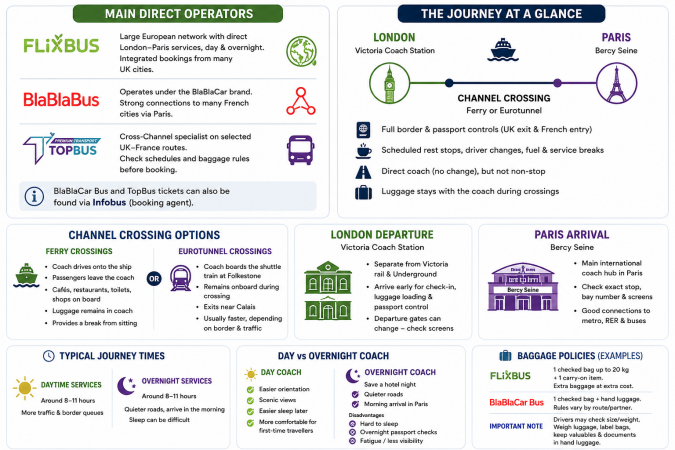
FlixBus is currently one of the largest operators on the London–Paris corridor. Unlike traditional coach companies, FlixBus functions primarily as a European network platform integrating many operating partners into one digital system. This means routes can vary slightly depending on date, some services operate daytime, others overnight, crossing type may vary and schedules are highly dynamic. One major advantage of FlixBus is that some passengers can book domestic UK feeder services and the London–Paris section within one integrated reservation. This can be useful for passengers travelling from Manchester, Birmingham, Bristol, Leeds, Liverpool, Cardiff, Glasgow, Edinburgh and other UK cities.
BlaBlaCar Bus
BlaBlaBus now generally operates under the wider BlaBlaCar branding, probably because the BlaBlaCar name has stronger recognition across Europe. Operationally, BlaBlaCar Bus is particularly important because of its strong integration with the French domestic coach market. Paris therefore functions not only as a destination, but also as a redistribution hub for onward travel across France. Passengers arriving in Paris can often continue towards Lyon, Marseille, Bordeaux, Toulouse, Strasbourg, Nantes, Montpellier, Nice and other French cities.
TopBus
TopBus represents a newer generation of cross-Channel coach operator focused on selected UK–France and Benelux corridors. Unlike FlixBus, which functions as a massive European network, TopBus appears more focused on direct corridor-style operations between major cities. As with all newer operators, passengers should carefully verify exact departure points, baggage rules and current timetable information before travelling.
London Victoria Coach Station
Almost all direct London–Paris coach services begin at London Victoria Coach Station. One of the most important things for first-time passengers to understand is that Victoria Coach Station, Victoria railway station, Victoria Underground station and local London bus stops are separate facilities. Passengers should allow additional time before departure because international coach journeys involve ticket checks, luggage loading, gate allocation, passport procedures and border formalities. Unlike airport-style terminals, Victoria Coach Station remains a functioning long-distance coach terminal with a mixture of domestic departures, airport coaches and international services all operating simultaneously. Departure gates may change at short notice, especially during busy evening departures.
How direct is a “direct” London–Paris coach?
This is one of the most misunderstood aspects of international coach travel. A direct coach normally means passengers remain on the same vehicle, without changing coaches, between London and Paris. However, this does not mean non-stop travel or uninterrupted movement. Typical operational pauses may include:
- border controls,
- ferry or Eurotunnel loading,
- customs inspections,
- rest breaks,
- fuel stops,
- driver changes,
- and motorway service stops.
Some London to Paris coach services may also make intermediate stops in Lille, Calais or northern France, depending on the operator and operational requirements.
Ferry crossings and Eurotunnel
One of the most interesting operational elements of London–Paris coach travel is the Channel crossing itself. Depending on operator, timetable and operational conditions, coaches may cross the Channel using ferry services or Eurotunnel shuttle operations.
Ferry crossings
On ferry-based services, the coach drives onto the vessel, passengers usually leave the coach and spend the crossing inside the passenger areas of the ship. This often provides cafés, restaurants, toilets, seating areas and shops. Checked luggage usually remains inside the coach during the crossing and is generally inaccessible until arrival in France. Ferry crossings can feel less stressful for some passengers because they provide a genuine break from sitting onboard.
Eurotunnel crossings
On Eurotunnel services, the coach boards a shuttle train at Folkestone, remains onboard the train during the crossing and exits near Calais. Eurotunnel is usually faster than ferry operations, although total journey time still depends heavily on immigration procedures, traffic, loading operations and motorway conditions. Some passengers never actually realise they are travelling beneath the Channel because the coach remains onboard the shuttle throughout the crossing.
Brexit and border controls
Since Brexit, coach travel between London and Paris involves full international border procedures. Passengers should expect UK exit checks, French immigration controls, Schengen passport checks, customs procedures and possible baggage inspections. Border procedures may occur before boarding, during the Channel crossing or after arrival, depending on operational arrangements. Journey times can vary significantly because of border queues, traffic, security checks, customs inspections and seasonal congestion. Passengers should therefore treat published journey times as approximate rather than guaranteed.
Paris Bercy Seine coach station
Most direct London–Paris coach services now use Paris Bercy Seine rather than the older Gallieni coach station traditionally associated with Eurolines. Bercy Seine has become one of the largest international coach hubs in Europe and functions as the main redistribution point for domestic French coach routes, international services and wider European coach travel. This is a very different environment from a traditional railway station. Passengers should carefully verify exact stop location, bay number, operator branding, departure screen information and GPS coordinates shown on the ticket. In Paris, the exact stop shown on the ticket is often more important than simply knowing the word “Bercy”.
Typical journey times
Approximate direct journey times between London and Paris are usually around 8–11 hours during the day, or overnight depending on schedule. However, timings vary significantly depending on border conditions, traffic, crossing method, motorway congestion and operational delays. Overnight services may sometimes feel faster operationally because they avoid daytime motorway congestion around London and Paris.
| Journey type | Typical pattern |
|---|---|
| Daytime coach | Usually easier for first-time travellers, but more exposed to daytime traffic and border queues. |
| Evening / overnight coach | Can save a hotel night, but sleep may be difficult and border checks may happen overnight. |
| Direct coach | No coach change, but may still involve stops, border controls, ferry or Eurotunnel procedures. |
Day coach or overnight coach?
Daytime travel
Daytime coach travel offers easier orientation, scenery through Kent and northern France, easier sleep later and a more comfortable experience for first-time passengers. The main disadvantages are motorway congestion, daytime border queues and a longer perceived journey time.
Overnight travel
Overnight coach travel can save hotel costs, use quieter roads and allow arrival in Paris in the morning. The disadvantages are difficult sleep onboard, overnight passport checks, fatigue and less visibility during the journey.
Baggage policies and operational realities
One major advantage of coach travel compared with low-cost airlines remains baggage flexibility. However, baggage policies differ significantly between operators.
FlixBus
FlixBus typically includes one checked bag up to 20 kg plus one carry-on item. Extra baggage may require advance booking, additional fees and available luggage space.
BlaBlaCar Bus & TopBus
BlaBlaCar Bus usually includes one checked bag and hand luggage, with additional baggage rules depending on route and operating partner.
Important operational note
Drivers may occasionally check luggage size, baggage quantity or overall weight. Passengers should therefore weigh luggage before departure, clearly label bags and keep valuables, medicines, chargers and documents in hand luggage.
What to keep in hand luggage
Recommended items include:
- passport,
- chargers,
- power bank,
- headphones,
- snacks,
- water,
- medicines,
- travel pillow,
- warm clothing,
- booking confirmations.
Because of border procedures and Channel operations, passengers may occasionally be separated from checked baggage for extended periods.
Why coach still survives despite Eurostar
This is one of the most fascinating aspects of the London–Paris transport market. Despite Eurostar’s speed advantage, coaches continue to survive because they serve a different market: cheaper travel, larger baggage, flexible booking, overnight transport, regional UK integration and continuation beyond Paris. Coach passengers are often less time-sensitive, more luggage-sensitive or travelling across wider European networks. For many passengers, the coach is not simply a substitute for Eurostar. It is an entirely different style of international travel.
FAQ — London to Paris by coach
Is there a direct coach from London to Paris?
Yes. Direct or direct-style coach services operate between London and Paris. Operators may include FlixBus, BlaBlaCar Bus and TopBus depending on date and availability.
How long does the London to Paris coach take?
Most direct London–Paris coach journeys take around 8–11 hours, although times can vary because of border procedures, traffic and the Channel crossing.
Where do coaches leave from in London?
Most direct London to Paris coach services depart from London Victoria Coach Station, which is separate from Victoria railway and Underground stations.
Where do coaches arrive in Paris?
Most services arrive at Paris Bercy Seine, the main long-distance coach hub in Paris. Always check the exact stop shown on your ticket.
Do London–Paris coaches use the ferry or Eurotunnel?
Both are possible. The crossing method depends on the operator, timetable and operating conditions.
Is the coach cheaper than Eurostar?
It can be cheaper, especially when Eurostar fares are high or when travelling with more luggage. However, prices vary by date and demand.
Can I travel overnight from London to Paris by coach?
Yes. Overnight coach services are often available, but passengers should expect possible passport checks and rest interruptions during the night.
Can I book from other UK cities to Paris?
Sometimes yes. FlixBus may offer integrated bookings from selected UK regional cities to Paris. Otherwise, passengers can book a separate coach or train to London first.
Do I need a passport after Brexit?
Yes. Travel between the UK and France involves full international border procedures and Schengen entry checks.
How much luggage can I take?
Baggage allowance depends on the operator. FlixBus usually includes one checked bag and one carry-on item. BlaBlaCar Bus rules may vary by booking and operating partner.
Final thoughts
Direct coach travel between London and Paris remains one of Europe’s most important and historically significant long-distance coach corridors. Modern services combine network-based operators, dynamic schedules, cross-Channel transport, immigration procedures and international long-distance coach operations in a way few other European routes still do. For passengers willing to accept a longer journey time, the London–Paris coach corridor continues to offer flexibility, affordability, operational simplicity and direct overland travel between two of Europe’s most important cities.