Travelling from the UK to Spain by coach
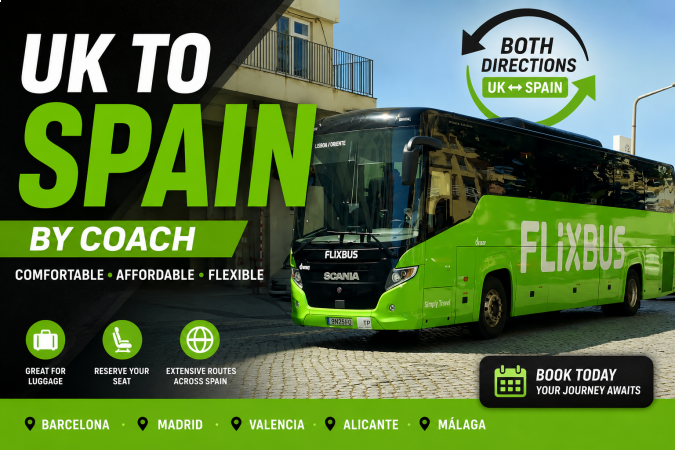
Travelling from the United Kingdom to Spain by coach has changed significantly in recent years. In the past, coach travel between the UK and Spain often relied on long-distance dedicated international services operating on fixed routes, sometimes redistributing passengers through visible interchange points before continuing towards destinations across Spain. Today, the model works differently. Most journeys between the UK and Spain are now operated through the wider FlixBus European network, using coordinated international coach corridors rather than one traditional long-distance vehicle travelling the entire distance. For passengers, this means something important: travelling to Spain by coach is usually easier and more flexible than many people expect. Instead of manually arranging separate tickets between different countries, passengers can often book one operator, one itinerary and coordinated international travel, with onward travel automatically integrated into the booking.
Quick navigation
- Book coach tickets
- Can you travel from the UK to Spain by coach?
- How coach travel from the UK to Spain works today
- Why Spain journeys sometimes look different
- International Interconnection Hubs explained
- How travel to Spain has changed since the Eurolines era
- Main gateways into Spain
- Destinations in Spain reachable from the UK by coach
- Travelling to Spain from outside London
- Journey times and travel realism
- Luggage, extra baggage and seat reservations
- Travelling between the UK and Spain after Brexit
- Travelling from Spain to the UK by coach
- FAQ
- Final thoughts
Book coach tickets from the UK to Spain
Use the links below to check live fares, journey options and current availability. For most UK to Spain journeys, FlixBus is the best first place to search because the system can often combine the UK, France and Spanish onward sections into one integrated reservation.
FlixBusRecommended for integrated UK to Spain journeys, often combining London, France, Spanish gateway cities and onward destinations in one booking. |
InfobusUseful for comparing wider European coach options, alternative routings and long-distance journeys to Spain. |
Tip: Search for your final Spanish destination rather than only Madrid or Barcelona. The booking system may automatically add the correct onward coach section.
Can you travel from the UK to Spain by coach?
Yes — absolutely. Spain remains one of the most extensive coach destinations reachable from the United Kingdom. However, modern coach travel to Spain does not usually work as one simple direct service. Unlike older international coach models, today’s journeys normally function through a wider European network with planned interchanges and coordinated onward travel. In practical terms, many journeys broadly follow travel corridors such as:
United Kingdom → France → Spain → final Spanish destination
or:
United Kingdom → France → northern Spain / Madrid / Barcelona → onward Spain
Depending on travel date, destination, operational coordination and available connections, different routes may appear even for the same Spanish destination. For many passengers, this flexibility is actually an advantage. Rather than relying on one infrequent weekly coach, travellers often benefit from daily departure opportunities and multiple journey combinations. Importantly, coach travel also works in both directions. Passengers travelling from Spain to the UK can normally use the same wider network with coordinated international connections.
How coach travel from the UK to Spain works today
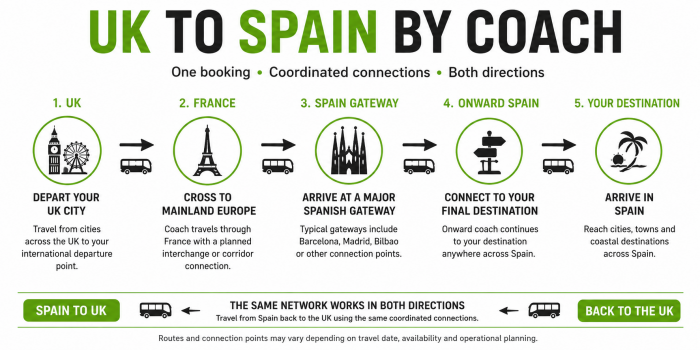
One of the biggest misunderstandings about Spain coach travel is the assumption that there must be one coach all the way from London to Spain. In reality, Spain works more like a network than a single route. Most journeys operate through international coach corridors followed by onward regional distribution inside Spain. This means a typical journey may involve:
London → mainland Europe → Spain gateway city → onward destination
For example:
- London → Paris → Barcelona → Valencia
- London → France → Madrid → Málaga
- London → Bilbao → northern Spain
For many travellers, the Spain journey feels more like one coordinated travel system rather than one extremely long coach route. This is usually handled automatically within the booking system. Passengers often do not need to manually organise French coach tickets, Spanish domestic sections or onward regional services. Instead, the booking system usually combines these sections into one itinerary.
Why Spain journeys sometimes look different
One thing many passengers notice when searching for UK to Spain coach tickets is that the route may look different on different days. This is completely normal. Unlike airlines or railways operating fixed corridors, long-distance coach networks are highly operational and dynamic. Some journeys may route through Paris. Others may route through Bordeaux, Barcelona, Madrid or northern Spain. Occasionally, journey combinations may also vary depending on season, demand and operational planning.
Checking several nearby travel dates can sometimes improve journey options considerably.
For longer journeys, especially to southern Spain, flexibility with travel dates can occasionally produce much shorter travel times or fewer interchanges.
International Interconnection Hubs explained
When searching for coach travel to Spain, some passengers may occasionally notice unfamiliar interchange points. Sometimes these may even appear as International Interconnection Hub. This can initially look confusing. However, these are usually operational transfer points used to coordinate international coach services. In practical terms, they function similarly to an airport transfer hub. Passengers may arrive on one international coach, transfer to another service and continue towards a different region of Spain. These are not usually intended as normal passenger destinations. Instead, they exist to coordinate long-distance international travel inside the network. For passengers, this normally still works as one coordinated journey rather than several separate bookings. The practical result is that Spain becomes reachable from the UK far more extensively than would be possible using only direct services.
How travel to Spain has changed since the Eurolines era
Long-time coach travellers may remember that UK to Spain journeys once worked very differently. Historically, many services relied on fixed international routes with visible interchange locations where passengers were redistributed towards destinations across Spain. Today, the principle still exists, but works differently. Instead of passengers manually understanding complicated international coach structures, much of the coordination is now integrated into the booking system. In practical terms, the modern system often feels simpler for passengers, but more flexible operationally. This allows access to considerably more Spanish destinations, more frequent travel opportunities, better onward connectivity and more flexible route planning.
Main gateways into Spain
Although Spain has an extensive coach network, certain cities act as major gateways for onward travel. Understanding these gateways helps explain why journeys are routed the way they are.
Barcelona — gateway to eastern Spain
Barcelona is one of the most important entry points into Spain. It often acts as a hub for onward travel towards Valencia, Alicante, Murcia, Tarragona, Costa Brava, Mediterranean Spain and occasionally southern Spain. For many travellers heading towards the Costa Blanca or eastern Spain, Barcelona often becomes the most practical gateway. Because of its strong international coach links, Barcelona is frequently one of the easiest Spanish cities to reach from the UK.
Madrid — gateway to central and southern Spain
Madrid plays a different role. As Spain’s central transport hub, it often acts as the gateway towards Córdoba, Seville, Málaga, Granada, Andalusia and western Spain. For many longer-distance journeys, Madrid acts as Spain’s internal redistribution point. Passengers travelling to southern Spain may therefore frequently see Madrid included as an interchange.
Bilbao and San Sebastián — gateway to northern Spain
For passengers travelling to northern Spain, the Basque Country, Cantabria, Asturias or Galicia, routes may occasionally enter Spain through Bilbao or San Sebastián / Donostia. These northern gateways can sometimes offer shorter routings for travellers heading towards northern Spain rather than southern coastal areas.
Valencia and Alicante corridor — popular with expats and holiday travellers
For many UK passengers, the Mediterranean coast remains one of the most popular parts of Spain. Destinations such as Valencia, Alicante, Benidorm, Murcia and the Costa Blanca are frequently searched by expats, second-home owners, long-stay visitors and holiday travellers. Many journeys towards this corridor often operate via Barcelona or occasionally Madrid.
Málaga and Costa del Sol — long-distance Spain travel
For passengers travelling towards the Costa del Sol, journeys naturally become longer. Destinations such as Málaga, Marbella and Andalusia often involve additional onward travel within Spain. However, coach travel still remains possible and for passengers carrying more luggage or staying for longer periods, it can remain a practical alternative to flying.
Destinations in Spain reachable from the UK by coach
One of the biggest advantages of modern coach travel to Spain is the sheer number of destinations that can be reached through the wider network. Unlike older fixed international coach systems, passengers are no longer limited to only one or two Spanish cities. Today, journeys can often continue beyond the main gateway cities towards destinations across northern Spain, the Mediterranean coast, central Spain, Andalusia and Galicia. Below are some of the main Spanish destinations that can typically be reached from the UK through coordinated coach travel. Journey times are approximate and may vary depending on travel date, interchange times, operational routing, border conditions and onward Spanish coach availability.
| Destination in Spain | Typical route from the UK | Most common interchange(s) | Approximate travel time |
|---|---|---|---|
| Alicante | London → France → Barcelona → Alicante | Paris / Barcelona | 33–42h |
| Algeciras | London → France → Madrid → southern Spain | Paris / Madrid | 42–55h |
| Badajoz | London → France → Madrid → Badajoz | Paris / Madrid | 35–45h |
| Barcelona | London → France → Barcelona | Paris | 25–35h |
| Benidorm | London → France → Barcelona → Alicante / Benidorm | Paris / Barcelona | 35–45h |
| Bilbao | London → France → Bilbao | Paris / Bordeaux | 24–34h |
| Burgos | London → France → northern Spain → Burgos | Paris / Bilbao | 28–38h |
| Cáceres | London → France → Madrid → Cáceres | Paris / Madrid | 36–46h |
| Castellón de la Plana | London → France → Barcelona → Castellón | Paris / Barcelona | 30–40h |
| Córdoba | London → France → Madrid → Córdoba | Paris / Madrid | 38–48h |
| Girona | London → France → Barcelona → Girona | Paris / Barcelona | 27–36h |
| Granada | London → France → Madrid → Granada | Paris / Madrid | 40–52h |
| Huelva | London → France → Madrid → Andalusia | Paris / Madrid | 42–54h |
| Irún | London → France → northern Spain | Paris / Bordeaux | 23–33h |
| Jaén | London → France → Madrid → Jaén | Paris / Madrid | 40–50h |
| León | London → France → northern Spain | Paris / Bilbao | 34–44h |
| Lloret de Mar | London → France → Barcelona → Costa Brava | Paris / Barcelona | 29–38h |
| Madrid | London → France → Madrid | Paris | 30–40h |
| Málaga | London → France → Madrid → Málaga | Paris / Madrid | 40–52h |
| Marbella | London → France → Madrid → Costa del Sol | Paris / Madrid / Málaga | 42–54h |
| Mérida | London → France → Madrid → Mérida | Paris / Madrid | 35–45h |
| Murcia | London → France → Barcelona → Murcia | Paris / Barcelona | 35–45h |
| Oviedo | London → France → northern Spain | Paris / Bilbao | 33–43h |
| Pamplona | London → France → northern Spain | Paris / Bilbao | 27–37h |
| Salamanca | London → France → Madrid → Salamanca | Paris / Madrid | 33–43h |
| San Sebastián / Donostia | London → France → northern Spain | Paris / Bordeaux | 24–34h |
| Santander | London → France → northern Spain | Paris / Bilbao | 29–39h |
| Santiago de Compostela | London → France → northern Spain → Galicia | Paris / Bilbao / Madrid | 40–52h |
| Seville | London → France → Madrid → Seville | Paris / Madrid | 39–50h |
| Tarragona | London → France → Barcelona → Tarragona | Paris / Barcelona | 27–37h |
| Toledo | London → France → Madrid → Toledo | Paris / Madrid | 32–42h |
| Valencia | London → France → Barcelona → Valencia | Paris / Barcelona | 31–41h |
| Valladolid | London → France → northern Spain / Madrid | Paris / Madrid | 31–41h |
| Vigo | London → France → Galicia | Paris / Bilbao / Madrid | 42–55h |
| Vitoria-Gasteiz | London → France → northern Spain | Paris / Bilbao | 26–36h |
| Zamora | London → France → Madrid / north-west Spain | Paris / Madrid | 34–44h |
| Zaragoza | London → France → Barcelona / Madrid | Paris / Barcelona | 28–38h |
Depending on travel date and operational coordination, some journeys may route via different interchange points. Barcelona, Madrid, Bilbao and selected international interconnection hubs often play an important role in onward travel across Spain.
Travelling to Spain from outside London
Many passengers travelling to Spain do not actually begin their journey in London. One of the biggest practical advantages of the modern FlixBus network is that the booking system can often automatically combine domestic UK coach travel with onward Spain travel within one integrated itinerary. This means passengers can often travel from cities such as:
- Manchester,
- Birmingham,
- Liverpool,
- Leeds,
- Bristol,
- Cardiff,
- Glasgow,
- Edinburgh,
- Newcastle,
- and many other parts of the UK.
A journey may therefore look something like:
Manchester → London → Paris → Barcelona → Alicante
or:
Birmingham → France → Madrid → Málaga
depending on travel date, operational routing and destination. FlixBus often combines these sections automatically into one booking. Passengers therefore usually do not need to manually organise separate UK coach tickets, French sections or onward Spanish travel.
Journey times and travel realism
Spain is a large country, and this matters when planning long-distance coach travel. Passengers travelling to Barcelona or northern Spain will usually experience shorter journeys than those travelling towards the Costa del Sol or Andalusia. In general, journey times usually range from around 25 to 55+ hours depending on destination. Travellers should remember that Spain coach travel involves international road travel, motorway traffic, border procedures, interchange time and operational coordination. Published journey times should therefore always be treated as approximate rather than guaranteed. For southern Spain, flexibility with departure dates can occasionally produce much better journey options. For many passengers, overnight departures can also make the journey feel considerably easier.
Luggage, extra baggage and seat reservations
One of the biggest reasons passengers still choose coach travel to Spain remains luggage flexibility. This can be especially useful for second-home owners, long stays, family visits, relocation, students and expats travelling between the UK and Spain. Standard FlixBus tickets usually include hand luggage plus one checked suitcase stored inside the luggage compartment. However, exact baggage allowances may occasionally vary depending on route and operational provider.
Can you add extra luggage?
Usually, yes. Additional hold luggage can often be added during booking, later through booking management or via the FlixBus app, subject to available space.
Seat reservations
Passengers can also often reserve front-row seats, panoramic seats, table seats or extra-legroom seating for an additional fee. On journeys that may last well over a day, seat choice can genuinely improve comfort. Useful comfort items for Spain coach travel often include:
- neck pillow,
- headphones,
- sleep mask,
- phone charger,
- power bank,
- snacks,
- water,
- and light warm clothing.
Travelling between the UK and Spain after Brexit
Travel between the United Kingdom and Spain now involves international travel between the UK and the European Union / Schengen Area, and passengers should understand that travel procedures are no longer the same as before Brexit. Because coach travel often involves multiple countries and several international borders, document requirements matter. Depending on nationality and immigration status, requirements may differ considerably.
EU citizens travelling from Spain to the UK
Passengers travelling from Spain or other EU countries to the United Kingdom should carefully check their travel status before departure. Many European travellers now require ETA — Electronic Travel Authorisation before travelling to the United Kingdom. ETA is generally required for short tourist visits, family visits, business travel and short stays. However, many people living in the UK do not need an ETA. If you already hold Settled Status, Pre-Settled Status, a UK visa or another form of immigration permission, you generally do not need an ETA. This is particularly important for Spanish, Polish, Romanian and other EU citizens living in the UK who may travel regularly between Spain and the United Kingdom.
Very important — check your UKVI account
If you hold Settled or Pre-Settled Status, you should make sure your passport is correctly linked to your UKVI account before travelling. If you renew your passport and fail to update your UK immigration account, boarding problems can occasionally happen. Passengers should therefore verify passport details, travel document validity and immigration records before starting the journey.
British travellers going to Spain
British citizens travelling to Spain can still normally visit without a visa for short stays. However, Spain is part of the Schengen Area and post-Brexit travel rules now apply. British travellers should normally expect the 90/180 rule. This generally means up to 90 days within any rolling 180-day period inside the Schengen Area. For holiday travellers, this is usually not a problem. However, long stays, second-home arrangements or repeated travel should be monitored carefully.
Passport validity matters
British travellers should also ensure their passport meets EU validity requirements. In practical terms, passports should normally be valid for the duration of travel, contain enough remaining validity and comply with Schengen entry rules. Because requirements occasionally change, checking current travel guidance before departure remains sensible.
EES — new biometric entry system
Spain and the wider Schengen Area are also gradually introducing EES — Entry/Exit System for non-EU travellers. For British passengers, this may mean additional border procedures such as passport scanning, facial recognition and biometric registration. For coach passengers, this may occasionally mean slightly longer border procedures than in previous years, particularly during summer holiday periods, weekends and busy travel seasons.
ETIAS — expected future travel authorisation
In the future, British travellers visiting Spain and other Schengen countries are expected to require ETIAS — European Travel Information and Authorisation System. This will work similarly to UK ETA, US ESTA or other electronic travel permissions. Implementation timelines may still change, so passengers should always check the latest requirements before travel.
Travelling from Spain to the UK by coach
Coach travel works in both directions. Passengers travelling from Spain to the United Kingdom can normally use the same wider FlixBus network with coordinated onward travel. Journeys often begin in Barcelona, Madrid, Valencia, Alicante, Málaga, Seville, Bilbao, San Sebastián, northern Spain or Costa del Sol destinations before continuing through mainland Europe, France and the United Kingdom. In practical terms, a return journey may look something like:
Málaga → Madrid → France → London
or:
Valencia → Barcelona → Paris → United Kingdom
depending on destination, travel date, operational coordination and onward UK connections. As with UK departures, one booking often covers the entire journey, meaning passengers usually do not need to manually organise separate French sections, UK connections or additional international tickets.
FAQ — UK to Spain by coach
Can you travel from the UK to Spain by coach?
Yes. Spain remains one of the largest coach destinations reachable from the UK using the wider FlixBus network and coordinated international travel.
Is there a direct coach from London to Spain?
Not usually in the traditional sense. Most journeys work through international coach corridors and planned interchanges rather than one continuous vehicle. However, the whole journey can often be booked as one itinerary.
Why do I sometimes see strange interchange points?
Some journeys use International Interconnection Hubs, which are operational transfer points used to coordinate international coach services. These are not usually passenger destinations in the normal sense.
What is the best route to Spain by coach?
This depends on destination. Barcelona works well for eastern Spain and Costa Blanca, Madrid works well for central and southern Spain, while Bilbao and San Sebastián often work well for northern Spain.
Can I travel to Costa del Sol by coach?
Yes. Destinations such as Málaga and Marbella can normally be reached through coordinated onward travel, usually via Madrid or other Spanish interchange points.
Can I travel to Benidorm or Alicante by coach?
Yes. Many Mediterranean destinations can usually be reached via the Barcelona → Valencia / Alicante corridor.
Can I travel from outside London?
Yes. Domestic UK coach sections are often automatically added to the itinerary. Passengers can frequently begin travel from cities such as Manchester, Birmingham, Leeds, Liverpool, Glasgow, Cardiff and many others.
Can I add extra luggage?
Usually yes. Additional baggage can often be added during booking or later through booking management, subject to available space.
Do EU citizens need ETA to enter the UK?
Many short-term visitors now require ETA — Electronic Travel Authorisation. However, people with Settled or Pre-Settled Status generally do not need ETA.
Do British citizens need a visa for Spain?
Normally no for short stays. However, Schengen rules, passport validity requirements and the 90/180 rule apply.
Can I travel from Spain back to the UK by coach?
Yes. The same wider coach network usually works in both directions. Passengers can normally travel from Spain back to the UK using coordinated international routes.
Final thoughts
Travelling between the United Kingdom and Spain by coach remains one of Europe’s most extensive overland travel options. Unlike older fixed-route international coach systems, today’s journeys usually work through a wider European network with coordinated onward travel. This allows passengers to reach major Spanish cities, Mediterranean destinations, Costa del Sol, northern Spain and other regions through one integrated system. For many travellers, coach travel remains a practical alternative to flying, particularly for long stays, larger luggage allowances, second-home travel, relocation or passengers simply preferring overland travel. Most importantly, Spain remains reachable from the UK in both directions through one connected international network.