Travelling from the UK to Ireland by coach
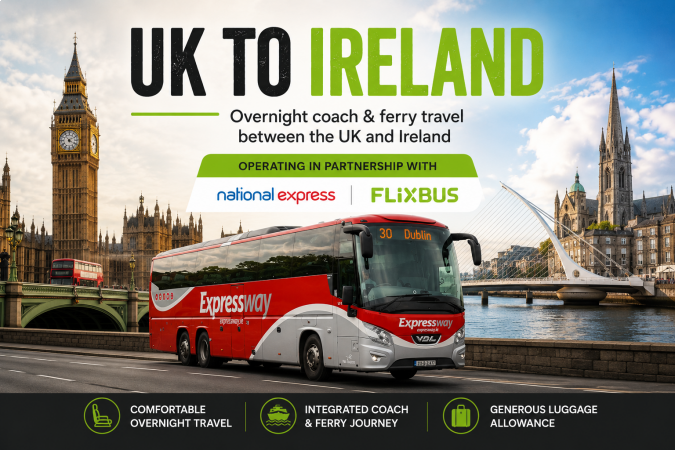
International coach travel between the United Kingdom and Ireland remains one of the most distinctive long-distance transport markets in Europe. Unlike purely continental coach corridors, journeys between Britain and Ireland combine motorway coach travel with maritime ferry operations across the Irish Sea. This creates a hybrid transport model where coach operators, ferry companies and domestic feeder networks function together as part of one integrated overland transport system. Despite the growth of low-cost airlines, coach and ferry travel between Britain and Ireland continues to serve passengers travelling with larger luggage, students, overnight travellers, budget-conscious passengers, regional passengers outside major airports and travellers connecting onwards within Ireland.
Passengers should always verify live schedules before travelling, especially because ferry-integrated coach routes can be affected by weather, port procedures and operational changes.
Quick navigation
- Book coach tickets
- How UK to Ireland coach travel works
- London to Dublin coach corridor
- London ⇄ Dublin timetable
- Ferry integration
- National Express
- FlixBus
- Bus Éireann Expressway
- Ireland coach network
- Main stations and terminals
- Tickets and booking systems
- Luggage and ferry travel
- Journey experience
- Practical advice
- FAQ
- Final thoughts
Book coach tickets from the UK to Ireland
Use the links below to compare coach ticket options between Britain and Ireland. National Express should usually be checked first for the classic UK-side corridor and feeder network, FlixBus may sell the same London–Dublin corridor through its platform, while Bus Éireann Expressway provides the Irish operator and onward Ireland network context. They all provide tickets for the same service between London and Dublin.
National ExpressBest starting point for the classic UK–Ireland coach and ferry corridor, including London, Birmingham and Holyhead integration. |
FlixBusUseful for checking London–Dublin availability where FlixBus acts as a booking platform for Bus Éireann-operated services. |
Bus Éireann ExpresswayOfficial Irish operator information for Expressway, Eurolines-style Ireland services and onward coach travel across Ireland. |
Tip: On UK–Ireland coach and ferry journeys, always check who physically operates the service, whether the ferry is included, luggage rules, port instructions and live departure information.
How coach travel between the UK and Ireland actually works
Modern coach travel between Britain and Ireland functions as a combined motorway and ferry transport corridor.
A typical journey usually includes:
- long-distance motorway coach travel in Britain
- arrival at a ferry port
- maritime crossing across the Irish Sea
- continuation by coach within Ireland
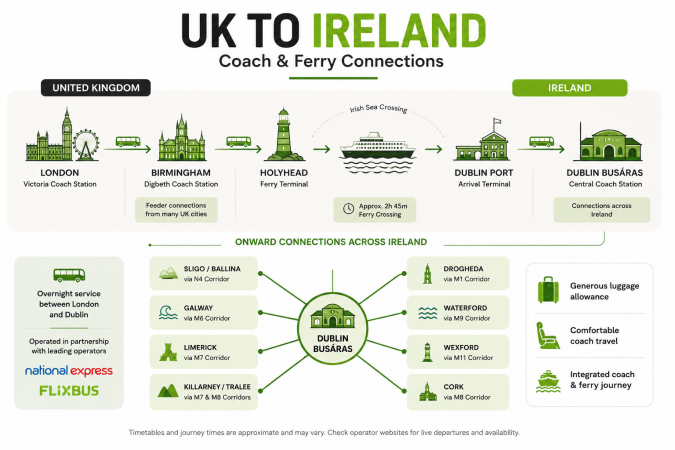
The most important operational corridor currently links London Victoria Coach Station, Birmingham Digbeth Coach Station, Holyhead Ferry Terminal, Dublin Ferry Port and Dublin Busáras. Operationally, the journey functions more like a rail-ferry integrated corridor than a standard domestic coach route. The coach, ferry and Irish domestic network all form part of one wider travel chain.
The London–Dublin coach corridor
One of the key operational corridors in the market is the overnight London–Dublin service traditionally associated with the 871 service (corridor). This is not a simple city-to-city coach route. It is an integrated coach-and-ferry corridor linking London and Birmingham with Holyhead, Dublin Port and Dublin Busáras. Total journey times are typically around 12–13 hours, depending on ferry conditions, motorway traffic and operational factors.
Typical London ⇄ Dublin coach and ferry timetable
The London–Dublin corridor operates primarily as an overnight coach-and-ferry route integrated with Irish Sea ferry crossings. Passengers should remember that timings may vary depending on ferry schedules, traffic conditions, weather and operational changes.
London ► Dublin
| Stop | Typical timing |
|---|---|
| London Victoria Coach Station | 17:00 |
| Birmingham Digbeth Coach Station | around 20:00 |
| Holyhead Ferry Terminal | shortly after midnight |
| Dublin Ferry Port | around 05:00 |
| Dublin Busáras | around 05:15 |
Dublin ► London
| Stop | Typical timing |
|---|---|
| Dublin Busáras | 17:45 |
| Dublin Ferry Port | around 18:15 |
| Holyhead Ferry Terminal | around 23:15 |
| Birmingham Digbeth Coach Station | overnight |
| London Victoria Coach Station | around 06:20 |
These times should be treated as practical timetable guidance rather than a permanent guarantee. Always check the live booking system before travelling.
Ferry integration and intermodal operation
One of the most distinctive operational aspects of UK–Ireland coach travel is ferry integration. Unlike continental European coach routes where vehicles remain entirely on motorways, UK–Ireland coach services depend on scheduled maritime crossings between Holyhead and Dublin Port. This means the coach itself normally boards the ferry together with passengers and luggage. Coach schedules are tied to ferry timetables, maritime weather can affect punctuality and port security or boarding procedures form part of the journey. From the passenger perspective, the ferry section often provides an opportunity to walk around, access food and seating areas, use onboard facilities and temporarily leave the coach environment.
Sea crossings
Sea crossings are made by ship, to the south of Ireland with Irish Ferries and to Northern Ireland with Stena Line or P&O Ferries, check timetables for specific information. On arrival at your ferry port, passengers are normally required to disembark from the coach and pass through border control and show photo identification. Normally customers are not required to be accompanied by their luggage, however occasionally Border Control officials do require customers to take their own luggage with them.
| Holyhead to Dublin Port on Irish Ferries ▶▶▶ | Guide | Pembroke Dock to Rosslare on Irish Ferries ▶▶▶ | Guide |
|---|
National Express and feeder operations
National Express plays a major role in the Britain-side feeder structure of the corridor. Operationally, National Express provides London Victoria departures, Birmingham integration, UK regional feeder connections and access to long-distance motorway corridors. This is important because passengers travelling from elsewhere in Britain may connect into the Ireland corridor through cities such as Manchester, Leeds, Bristol, Cardiff, Newcastle, Glasgow, Edinburgh and many other UK cities. The Birmingham stop is operationally significant because it acts as a secondary interchange point for passengers joining the corridor from other parts of Britain.
FlixBus and ticket distribution
An interesting modern development is the appearance of UK–Ireland journeys inside the FlixBus booking system. Current booking data suggests that FlixBus may sell tickets on the London–Dublin service 871 while the physical operation itself is carried out by Irish operators such as Bus Éireann Expressway. Operationally, this means FlixBus functions primarily as a ticket distributor, booking intermediary and sales platform rather than the physical operating carrier on the Ireland corridor itself. Passengers should therefore always verify the actual operating carrier, luggage policies, boarding procedures and operator conditions, particularly on international ferry-integrated corridors.
Bus Éireann Expressway and the Irish domestic network
Bus Éireann Expressway plays a central role within the Irish side of the network. Historically, Expressway developed as Ireland’s long-distance coach system linking Dublin with regional Irish cities and towns. Operationally, Dublin Busáras functions as the core interchange hub of the national network. From Dublin, passengers can continue towards Cork, Galway, Limerick, Waterford, Wexford, Sligo, Ballina, Donegal, Drogheda, Killarney, Tralee and many smaller regional destinations.
The wider Ireland network structure
For many passengers, the journey from Britain does not end in Dublin. Dublin Busáras acts as a national gateway into the wider Irish coach network. Bus Éireann Expressway allows bookings in Ireland.
Eastern corridor
The Dublin–Drogheda corridor forms part of the eastern motorway network and links with routes towards the northeast.
Southern corridor
The Dublin–Cork corridor is one of Ireland’s most important long-distance transport corridors.
Western corridor
The Dublin–Galway corridor provides access towards western Ireland and Atlantic regions.
South-west corridor
Routes towards Limerick, Killarney and Tralee form part of the south-west national coach structure.
North-west corridor
Routes towards Sligo, Ballina and Donegal provide important regional connectivity for western and north-western Ireland.
Main coach stations and interchange points
London Victoria Coach Station
The main British departure hub for Ireland-bound services. Passengers should allow additional time because Victoria Coach Station is separate from Victoria railway station, Victoria Underground station and local bus services.
Birmingham Digbeth Coach Station
A major intermediate interchange point within the Britain-side network. It is operationally important for feeder passengers, driver changes and wider UK network integration.
Holyhead Ferry Terminal
The principal maritime gateway between Britain and Ireland for the coach corridor. Passengers should expect ferry boarding procedures, document checks where applicable and operational coordination between coach and ferry operators.
Dublin Ferry Port
The maritime arrival point in Ireland before continuation into central Dublin.
Dublin Busáras
The central coach terminal in Dublin and the primary hub of the Irish long-distance coach network. Busáras functions as Ireland’s main coach interchange, a domestic Expressway hub and the principal onward distribution point for passengers arriving from Britain.
Passengers should always verify live schedules before travelling, especially because ferry-integrated coach routes can be affected by weather, port procedures and operational changes.
Tickets and booking systems
Several booking models currently coexist within the UK–Ireland market. Passengers may encounter direct operator sales, integrated through-ticketing, reseller platforms and intermediary sales systems. In some cases, the ticket seller, the branding and the physical operator may all differ. Passengers should therefore always verify who physically operates the coach, baggage rules, ferry inclusion, refund conditions and boarding procedures.
Luggage and ferry travel
Coach travel between Britain and Ireland remains popular partly because of luggage flexibility. Most operators typically include hold luggage and onboard hand luggage. However, ferry-integrated operation means passengers may occasionally need access items during ferry crossings, passports or documents during boarding and awareness of ferry security procedures. Passengers should label all luggage clearly, keep valuables with them and verify operator baggage policies before departure.
Journey experience
The UK–Ireland coach corridor is a genuine overnight intermodal journey. Passengers should expect motorway travel, overnight operation, ferry boarding, sea crossings, port procedures, changing weather conditions and early morning arrivals. However, many passengers continue to prefer the corridor because it offers simpler luggage handling, overnight travel, direct regional connectivity and integrated access across Ireland.
Practical advice for passengers
- Verify whether the ticket includes the ferry section.
- Check the actual operating carrier.
- Arrive early before departure.
- Carry passports or required travel documents.
- Allow for ferry-related delays.
- Keep valuables and medicines accessible.
- Verify onward Irish domestic connections.
- Check whether the journey uses Busáras or alternative stops.
- Bring chargers, snacks and warm clothing for overnight travel.
- Always verify live schedules before departure.
FAQ — UK to Ireland by coach
Is the London–Dublin coach direct?
Operationally yes, although the journey includes a ferry crossing between Holyhead and Dublin Port.
How long does the coach journey from London to Dublin take?
Usually around 12–13 hours depending on traffic, ferry schedules and operational conditions.
Does the coach go onto the ferry?
Yes. Typically the coach boards the ferry together with passengers and luggage.
Who operates the London–Dublin coach corridor?
Operations may involve National Express feeder integration, Bus Éireann Expressway operation and ticket sales through various platforms including FlixBus.
Does FlixBus physically operate the London–Dublin service?
Current booking information suggests FlixBus mainly acts as a ticket distribution platform, while the physical operation is carried out by Bus Éireann Expressway.
Can I continue beyond Dublin on the same network?
Yes. Dublin Busáras connects with the wider Irish Expressway network towards Cork, Galway, Limerick, Donegal and many other destinations.
Is luggage included?
Usually yes, although baggage allowances vary depending on operator and ticket type.
Is the journey overnight?
Yes. Most London–Dublin services operate overnight in at least one direction.
Should I rely on printed timetables?
No. Ferry-integrated coach operations can change depending on traffic, weather and operational conditions. Always verify live schedules before travelling.
Final thoughts
The UK–Ireland coach market is one of the most operationally interesting long-distance transport corridors in Europe because it combines motorway coach travel, maritime ferry integration, overnight operation and national feeder networks. Rather than functioning as a simple airport-style shuttle, the corridor operates as a fully integrated overland transport system linking Britain with the wider Irish domestic coach network. For many passengers, particularly those travelling beyond Dublin, carrying larger luggage or preferring overnight overland travel, coach and ferry transport remains a highly practical alternative to air travel.