Travelling from the UK to Italy by coach
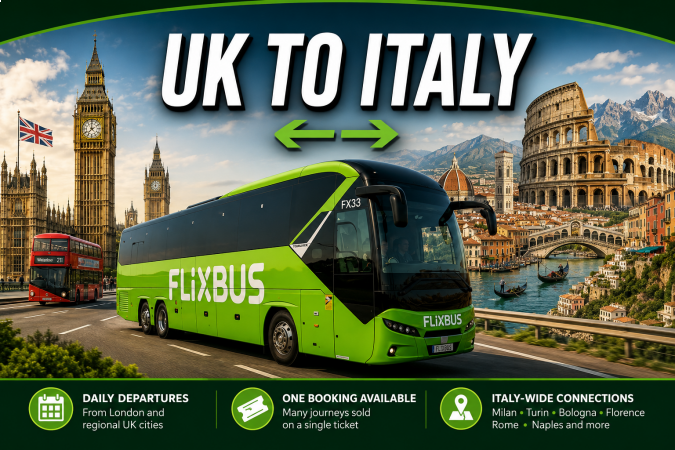
Italy is one of the most practical long-distance coach destinations from the UK. While there is no longer a traditional same-coach London to Italy service, modern FlixBus connections make it possible to reach a wide range of Italian cities by coach, often on one connected booking. For many travellers, the key to understanding UK to Italy coach travel is not simply looking for “London to Rome”. In practice, most journeys work through a European corridor, usually via France, Belgium or Germany, before entering northern Italy. From there, the Italian FlixBus network becomes much denser, with onward connections towards central Italy, southern Italy and even Sicily. This means that Turin and Milan often act as the main gateways into Italy, while cities such as Bologna, Florence, Rome, Naples, Bari, Catania and Palermo may require longer journey times or additional coach segments.
Quick Summary — UK to Italy by coach
- Can you travel entirely by coach? Yes.
- Main operator: FlixBus.
- Direct coach available? No — journeys normally involve transfers.
- Can you buy the whole trip on one booking? Often yes.
- Main transfer hubs: Paris, Lyon, Brussels or Frankfurt.
- Main Italian gateways: Turin and Milan.
- Typical journey time: around 22–50+ hours depending on destination.
- Passport required? Yes. Italy is part of the Schengen Area, but UK travellers still require a valid passport.
- Best for: city breaks, family visits, holidays, cheap travel and overland journeys.
Quick navigation
- Book coach tickets to Italy
- How coach travel from the UK to Italy works
- Main travel corridors to Italy
- Which Italian cities can you reach from the UK?
- Turin vs Milan vs Rome
- How to choose the best Italy connection
- Typical journey times
- What is the journey really like?
- Northern Italy as the gateway to the rest of Italy
- Travelling beyond Rome
- Travelling from outside London
- Italy airports reachable by coach
- Luggage allowance
- Additional luggage
- Seat reservations
- Extra seat option
- Comfort breaks & overnight travel
- Documents & Schengen
- FAQ
- Final thoughts
Book coach tickets to Italy
For UK to Italy coach travel, FlixBus is currently the main practical operator. Although other occasional or indirect options may exist, they are not usually as convenient for most passengers. For this guide, EuropeBus focuses on FlixBus because it offers the strongest combination of UK departures, international connections and Italian domestic coverage.
INFOBUS can also be useful as a comparison platform, especially when checking wider European coach options or alternative availability. However, for most UK to Italy journeys, FlixBus should normally be the first place to check.
FlixBusRecommended for UK to Italy coach journeys, including Turin, Milan, Bologna, Florence, Rome, Naples and more. |
INFOBUSUseful for comparing international coach options and wider European bus routes. |
Tickets are completed directly with the operator, FlixBus or INFOBUS. EuropeBus may receive a small affiliate commission at no extra cost to you.
How coach travel from the UK to Italy works
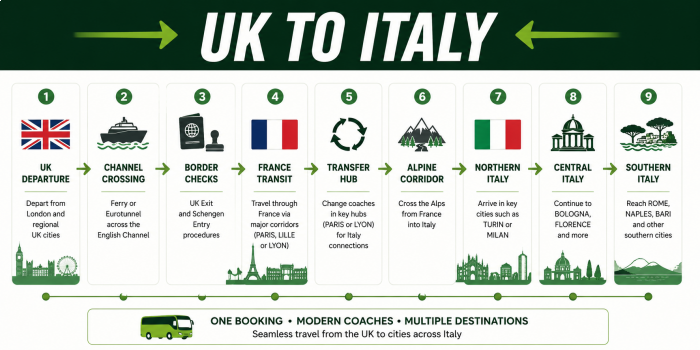
One of the most important things to understand is that UK to Italy coach travel is usually not a simple same-coach journey. In most cases, passengers travel through a connected European coach network, changing coaches at least once before continuing into Italy. Many itineraries can now be booked as one FlixBus booking, but one booking does not necessarily mean one coach. The actual journey may involve several operational segments, such as a UK departure, a Channel crossing, a transfer in France or Belgium, a long-distance coach towards northern Italy, and then an onward Italian coach section if travelling further south. A typical journey may look something like:
UK → Paris or Lyon → Turin or Milan → onward Italy
or:
UK → Brussels or Frankfurt → Northern Italy → onward Italy
This connection-based model is now normal for long-distance coach travel across Europe. The important practical point is to choose the itinerary carefully, prioritising sensible transfer times, fewer coach changes and the shortest overall journey time.
Main travel corridors to Italy
Italy can be reached from the UK through several European corridors. The best one depends on your destination, travel date and whether you are heading to northern Italy, central Italy, southern Italy or Sicily.
Paris corridor
The Paris corridor is one of the most common and useful routings for UK to Italy coach travel. Many journeys naturally follow a pattern such as UK → Paris → Turin / Milan. This can work particularly well for northern Italy and onward journeys towards Bologna, Florence or Rome.
Lyon corridor
Lyon is another important gateway, especially for routes entering Italy through the western Alpine corridor. A journey via Lyon may be useful for Turin, Milan and some onward Italian services, depending on timetable availability.
Brussels / Germany corridor
Some itineraries may route through Brussels, Frankfurt or other German hubs before continuing south into Italy. These options can occasionally be useful, but passengers should compare carefully, as they may involve longer travel times or more transfers than routes through France.
EuropeBus Tip:
For Italy, the best route is not always the cheapest one. A slightly more expensive itinerary with fewer transfers and a shorter total journey time can make a very long trip much more comfortable.
Which Italian cities can you reach from the UK by coach?
Italy has one of the densest FlixBus networks in Europe, and once passengers reach northern Italy, onward connections become much easier. For UK travellers, the most practical destinations are usually major cities, transport hubs and popular tourist centres rather than smaller towns. The following cities are among the main Italian destinations that can be considered for UK to Italy coach travel with FlixBus, depending on date, availability and transfer pattern.
| Region / area | Italian cities commonly worth checking |
|---|---|
| Northern Italy | Bergamo, Bologna, Como, Genoa, La Spezia, Milan, Modena, Padua, Parma, Trieste, Turin, Venice, Verona |
| Central Italy | Florence, Pisa, Rome |
| Southern Italy | Naples, Bari, Lecce, Reggio Calabria |
| Sicily | Messina, Catania, Palermo |
A–Z of key Italian destinations
Bari — useful for southern Italy and onward Adriatic travel, but journey times from the UK are naturally much longer than to northern Italy.
Bergamo — a practical northern Italian city and useful for Bergamo Airport, Milan access and onward travel.
Bologna — one of the most useful onward hubs in northern-central Italy, often a smarter stepping stone than travelling directly to smaller destinations.
Catania — possible as part of the wider Italian and Sicilian FlixBus network, but expect a very long journey from the UK.
Florence — a major destination for tourism and central Italy, usually reached via northern Italy or Bologna corridors.
Genoa — useful for Liguria and coastal northern Italy.
La Spezia — useful for Liguria and access towards the Cinque Terre area, although some travellers may find rail continuation easier from larger hubs.
Lecce — possible for southern Italy, but journey times are long and route choice should be checked carefully.
Messina — a gateway into Sicily, but significantly longer from the UK than destinations in northern or central Italy.
Milan — one of the most important Italian gateway cities for UK travellers. Milan often offers some of the fastest and simplest Italy itineraries.
Modena — reachable through the northern Italian coach network and useful for Emilia-Romagna.
Naples — possible entirely by coach, but expect longer travel times and more complex itineraries than to Milan, Turin or Bologna.
Padua — useful for north-eastern Italy and Venice region travel.
Palermo — possible through long-distance Italian and Sicilian services, but this is a very long overland journey from the UK.
Parma — useful for Emilia-Romagna and often more practical via northern Italian corridors.
Pisa — useful for Tuscany and Pisa Airport, often better considered alongside Florence or Bologna options.
Reggio Calabria — one of the furthest mainland Italian destinations to consider by coach from the UK.
Rome — one of the most searched Italy destinations, but not always the smartest first Italian city to choose if your priority is the shortest journey.
Trieste — useful for north-eastern Italy and onward Adriatic / Balkan travel.
Turin — one of the easiest Italian cities to reach from the UK, especially via France and the Alpine corridor.
Venice — a major tourist destination and useful north-eastern Italian hub.
Verona — useful for northern Italy, Lake Garda access and onward routes.
EuropeBus Tip:
For UK travellers, Turin, Milan, Bologna and Verona are often more practical first Italian targets than very distant destinations. If you are heading further south, it may be easier to reach northern Italy first and then continue through the Italian coach or rail network.
Turin vs Milan vs Rome — which is best?
Choosing the right first Italian city can make a major difference to journey comfort. Italy is long from north to south, so the most famous destination is not always the most efficient first target when travelling by coach from the UK.
Turin
Turin is often one of the easiest Italian cities to reach from the UK because it sits close to the French-Italian Alpine corridor. It can be a good choice if you want the shortest possible overland entry into Italy or if you are continuing towards north-western Italy.
Milan
Milan is usually the most useful all-round gateway into Italy. It has strong onward coach and rail connections, frequent services, airport access and a large transport network. For many travellers heading to central or southern Italy, Milan can be the best first arrival point before continuing further.
Rome
Rome is the classic destination, but it is not always the best first choice operationally. Journey times are much longer than to northern Italy, and some itineraries may require additional transfers. If the Rome itinerary is slow or awkward, consider checking Milan or Bologna first and continuing onwards.
How to choose the best UK to Italy coach connection
Italy offers many possible coach itineraries, but not all of them are equally comfortable. The smartest option is usually the one with the shortest journey time, the fewest transfers and the most sensible connection windows.
Prioritise shorter journey times
For Italy, journey times can vary significantly by date and destination. A London to Milan itinerary may be relatively efficient on one day and much longer on another. If the price difference is small, the faster journey is usually the better choice.
Fewer transfers are usually better
For most journeys to northern Italy, one transfer is ideal and two transfers can still be reasonable. If you see three or more coach changes, it may be worth checking a different date, a nearby Italian city or a different gateway such as Turin or Milan.
Watch overnight transfers carefully
Some cheaper itineraries may involve long overnight waits in Paris, Lyon, Brussels or Frankfurt. These can make a fare look attractive but feel uncomfortable in practice, especially on journeys lasting more than 24 hours.
Consider nearby destinations
If you are travelling to Florence, also check Bologna or Milan. If you are travelling to Naples, also check Rome. If you are travelling to a smaller city, it may be quicker to book to a major hub first and then continue locally.
EuropeBus Tip:
For Italy, the smartest itinerary is usually the one with the fewest transfers and the shortest overall journey time. Milan and Turin frequently provide the easiest entry points into the Italian coach network, while cities further south naturally require more travel time.
Typical journey times from the UK
Journey times to Italy depend heavily on destination, transfer hub, waiting times and departure city in the UK. Northern Italy is usually much faster to reach than central or southern Italy.
| Destination | Approximate journey time |
|---|---|
| Turin | 22–30h |
| Milan | 22–30h |
| Bologna | 24–34h |
| Florence | 26–38h |
| Rome | 30–42h |
| Naples | 34–50+h |
| Bari / Lecce / Sicily | Significantly longer |
A slightly longer itinerary may sometimes be more comfortable if it avoids very tight transfers or inconvenient overnight waiting periods.
What is the journey really like?
Travelling from the UK to Italy by coach feels different from journeys to Scandinavia or Eastern Europe. It is usually a Western European corridor journey, often passing through France before crossing the Alpine region and entering northern Italy. Depending on the route, passengers may travel through France, Belgium, Germany or Switzerland before reaching Italy. The most interesting part of the journey is often the approach towards the Alps and northern Italy, where the landscape changes from motorway corridors into mountain routes and Italian urban gateways. Passengers should expect overnight travel, motorway service station stops, at least one transfer and long-distance coach sections. For comfort, EuropeBus recommends bringing a power bank, snacks, downloaded entertainment, travel pillow, water bottle and a hoodie or light blanket.
Northern Italy as the gateway to the rest of Italy
One of the most important things to understand about travelling from the UK to Italy by coach is that many journeys do not really end when you reach the Italian border. In practice, northern Italy acts as the main gateway to the rest of the country. For many passengers, the first Italian cities reached are Turin, Milan, Bergamo or Verona. From there, the Italian FlixBus network becomes considerably denser, with onward services towards Bologna, Florence, Pisa, Rome, Naples, Bari and Sicily. This means that even if your final destination is further south, the fastest and simplest itinerary may involve reaching northern Italy first before continuing onwards.
EuropeBus Tip:
For many travellers heading to central or southern Italy, Milan is often the most useful arrival hub thanks to the large number of onward departures available throughout the day.
Travelling beyond Rome
Many first-time travellers assume that Rome represents the end of the Italian coach network. In reality, FlixBus operates extensive services south of Rome, including routes towards Naples, Bari, Lecce, Reggio Calabria, Messina, Catania and Palermo. Travelling entirely by coach from the UK to southern Italy is therefore possible, although journey times naturally become much longer. For many passengers, the key is to compare whether a single long itinerary is actually better than reaching Rome, Naples or Milan first and then continuing locally.
Travelling from outside London
One of the biggest improvements in recent years is that many passengers no longer need to begin their Italy journey in London. Because FlixBus increasingly sells through-ticketed itineraries, travellers can often begin their trip directly from cities across the UK on one booking, depending on timetable availability.
This may include Manchester, Birmingham, Bristol, Cardiff, Leeds, Nottingham, Leicester, Sheffield and other FlixBus-served locations. For example, a journey such as Manchester → Paris → Milan or Birmingham → Lyon → Turin may sometimes appear as one coordinated itinerary rather than separate reservations.
EuropeBus Tip:
Even when travelling on one itinerary, avoid the shortest possible transfer time. For long-distance coach travel to Italy, slightly longer transfer windows are often less stressful, particularly in hubs such as Paris, Lyon, Brussels or Milan.
Italy airports reachable by coach
FlixBus also serves several important Italian airports, which can be useful for travellers combining coach and air travel, meeting family members or using airports as regional transport hubs. Depending on route and availability, airport destinations worth checking may include Milan Malpensa Airport, Milan Linate Airport, Bergamo Airport, Venice Airport, Rome Fiumicino Airport, Rome Ciampino Airport and Naples Airport. For some itineraries, booking to an airport may be more convenient than booking to the city centre, especially if the airport is closer to your final destination or offers easier onward transport.
Luggage allowance
For most UK to Italy journeys, FlixBus normally includes 1 hold luggage item and 1 cabin bag within the standard fare. This is usually sufficient for city breaks and short holidays, but travellers heading to Italy for longer stays should check baggage conditions carefully before booking. Keep important items in your cabin bag, including passport, medication, chargers, valuables, snacks and spare clothing. This is especially important on journeys involving overnight travel or multiple transfers.
Additional luggage
Many FlixBus services also allow passengers to purchase additional luggage during the booking process. If the option is available on your itinerary, you may be able to add extra hold luggage, oversized luggage or special luggage items, subject to availability and operator conditions. This can be especially useful for travellers going to Italy for a longer holiday, study, work, family visits or extended stays. However, extra luggage should always be arranged during booking where possible, rather than assumed at the coach stop.
EuropeBus Tip:
If you need more than the standard allowance, check additional luggage options before completing your booking. Availability can vary by route, vehicle and operating segment.
Seat reservations
Although seat reservations are optional, they are strongly recommended for journeys to Italy that may exceed 20–40 hours depending on destination. A reserved seat can significantly improve comfort during overnight sections and long motorway journeys. Available options may include standard seats, window seats, aisle seats, front-row seats or table seats, depending on vehicle type and availability. On long journeys, aisle seats are often the most practical because they allow easier movement during comfort stops, while window seats may feel better for sleeping. On journeys involving transfers, seat reservations may not automatically continue after coach changes, so always check seat assignments for each segment after booking.
Extra seat option
On some FlixBus routes and booking flows, passengers may also be offered the option to purchase an additional seat for greater comfort and personal space. Availability varies and may not be offered on every itinerary. If available during booking, an extra seat can be useful for very long journeys, passengers travelling with delicate items or travellers wanting additional personal space. For Italy, this may be particularly attractive on routes lasting more than 24 hours.
Comfort breaks & overnight travel
Because Italy journeys are long, regular comfort breaks are part of the travel experience. Passengers should expect motorway service station stops, toilet breaks, food opportunities and overnight travel, especially on routes towards central and southern Italy. Food availability varies by country, stop location and time of day, so planning ahead is recommended. Overnight stops can sometimes be limited, and not every transfer point will have the same facilities available late at night.
EuropeBus Tip:
Do not rely entirely on motorway service stations. Bring snacks, drinks, charging cables and a power bank, especially for overnight sections and long transfers.
Documents & Schengen
Italy is part of the Schengen Area, but UK travellers still require a valid passport for international travel. Because coach travel crosses several countries, keep travel documents easily accessible throughout the journey rather than packed in hold luggage. Passengers may occasionally encounter operator document checks, boarding verification or passport inspections where required, particularly on international routes involving the UK and mainland Europe.
EuropeBus Tip:
Before travelling, always check passport validity, visa requirements if applicable and travel rules for non-UK nationals, especially for long international itineraries.
FAQ — UK to Italy by coach
Is there a direct coach from London to Italy?
No. There is currently no practical same-coach London to Italy service for most travellers. UK to Italy journeys normally involve one or more transfers, although FlixBus often sells the full journey as one booking.
What is the easiest Italian city to reach from the UK?
Turin and Milan are usually among the easiest Italian cities to reach by coach because they sit close to the main France to northern Italy corridor.
Is Rome easy to reach by coach from the UK?
Rome is reachable, but journeys are significantly longer than to northern Italy. If the Rome itinerary looks slow or complicated, consider checking Milan, Bologna or Florence first and continuing onwards.
Can I travel to southern Italy or Sicily by coach?
Yes, but journey times become much longer. Naples, Bari, Lecce, Reggio Calabria, Messina, Catania and Palermo may be possible through the wider Italian coach network, but routes should be checked carefully.
Can I start my journey outside London?
Often yes, depending on timetable availability. Many travellers can now begin from regional UK cities on one FlixBus booking without separate tickets.
Should I choose the cheapest Italy coach ticket?
Not always. For Italy, it is often better to choose the route with fewer transfers and a shorter total journey time, even if it costs slightly more. Very cheap fares can sometimes involve long overnight waits or inconvenient connections.
Final thoughts
Travelling from the UK to Italy by coach is no longer about a single historic route or one old-style coach service. Today, the journey works through FlixBus’ wider European network, with northern Italy acting as the main gateway to the rest of the country. For many travellers, Turin and Milan provide the simplest entry points, while Bologna, Florence and Rome become natural onward destinations. Southern Italy and Sicily are also possible, but they require more time, patience and careful itinerary selection. If you are looking for cheap travel, city-centre departures, flexible tickets and an overland alternative to flying, travelling to Italy by coach remains one of the most interesting long-distance journeys available from the UK.