Travelling from London to Luton Airport by coach
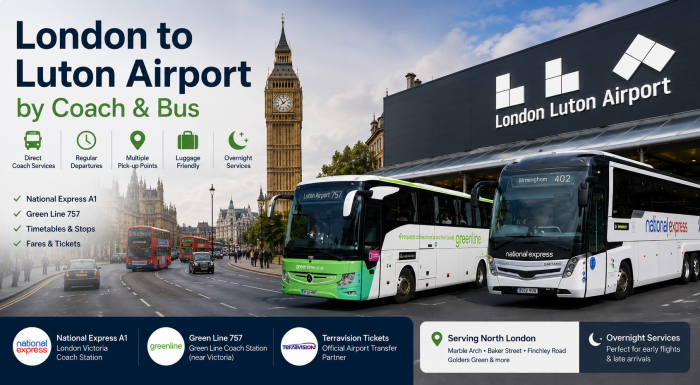
Travelling from London to Luton Airport by coach is one of the most established airport coach corridors in Britain. Unlike Heathrow, where airport coach transport is heavily fragmented across multiple national motorway corridors, the London–Luton market combines dedicated airport coach services, interurban airport corridors, regional commuter-style coach operations and overnight airport transport. Operationally, Luton Airport functions as one of London’s most coach-oriented airports. This is partly due to strong motorway access via the M1, the airport’s large low-cost airline market, substantial overnight passenger flows and the historical development of direct coach operations from Central and North London.
| Check National Express tickets | Check Green Line / Terravision tickets |
Quick navigation
- Two different operational models
- National Express A1
- Typical A1 service stopping pattern
- North London connectivity
- National Express A2
- Why the A2 service matters
- Green Line / Terravision / Arriva service 757
- Green Line Coach Station
- Typical Green Line 757 stopping pattern
- Route variations around Luton
- Frequency and pricing
- Luggage policies
- Airport-oriented optional extras
- FlixBus and Luton Airport
- Journey times
- Overnight airport operations
- Coach travel vs rail
- Practical advice
- Which operator may suit different passengers?
- FAQ
Two different operational models
Although both operators connect London with Luton Airport, they operate using very different transport philosophies.
National Express
National Express primarily operates airport-oriented coach corridors, luggage-focused services and long-distance interurban coach operations. The company’s services are designed mainly around airline passengers, airport transfers, overnight airport demand and national coach connectivity.
Green Line 757 with cooperation with Terravision & Arriva
Green Line 757 operates differently. Operationally, the 757 behaves more like a regional express coach, a North London interurban corridor and a high-frequency commuter-style airport route.
Although heavily used by airport passengers, the 757 also serves local mobility flows, suburban passengers and intermediate North London demand.
National Express A1 – the primary dedicated airport corridor
The main National Express route between London and Luton Airport is the A1.
This is the primary dedicated airport coach corridor linking London Victoria Coach Station, Central London, North London and Luton Airport.
Operationally, the A1 functions as a classic airport coach route focused heavily on airline passengers and airport transfers.
Unlike Heathrow, where multiple overlapping national corridors create airport connectivity, the A1 is specifically designed around London–Luton airport demand itself.
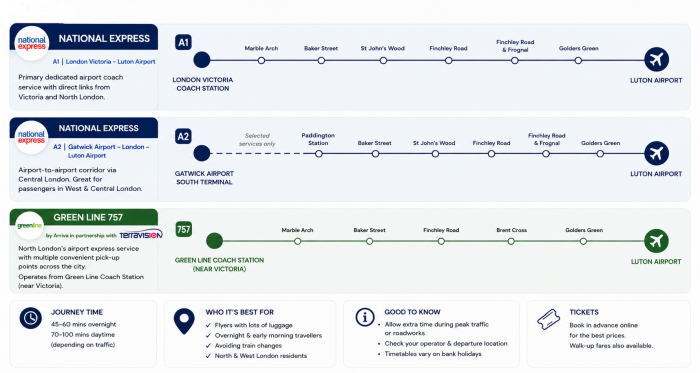
Typical A1 stopping pattern
The A1 normally serves:
- London Victoria Coach Station
- Victoria Rail Station
- Marble Arch
- Baker Street
- St John’s Wood
- Finchley Road
- Finchley Road & Frognal
- Golders Green
- Luton Airport
- limited extensions towards Milton Keynes Coachway on selected journeys
This creates very strong connectivity between Central London, North-West London and the airport corridor.
North London connectivity is extremely important
One of the defining characteristics of the London–Luton coach market is the importance of North London pickup points. Unlike Gatwick services, which are heavily Victoria-oriented, Luton coach operations depend strongly on intermediate North London demand. In practice, stops such as Golders Green, Finchley Road, Baker Street and St John’s Wood are not simply secondary pickup points. Operationally, they form a major part of the corridor itself. Golders Green in particular functions as a strategically important interchange because it provides Underground access, North London connectivity and efficient access towards the M1 motorway corridor.
National Express A2 – the additional airport corridor
Although the A1 is the primary dedicated London–Luton Airport route, it is not the only National Express service linking London with the airport.A significant additional airport corridor is the A2. Operationally, the A2 is not designed purely as a London–Luton shuttle. Instead, it functions as a longer through-airport corridor linking Gatwick Airport, Central London, North London and Luton Airport. Because the service passes through substantial parts of London, many passengers also use it simply for travel between London and Luton Airport.
Why the A2 matters operationally
The A2 effectively creates additional frequencies, additional overnight airport capacity and stronger connectivity across West and North London.
Typical A2 stopping patterns include:
- Victoria, selected services only
- Marble Arch
- Paddington
- Baker Street
- St John’s Wood
- Finchley Road
- Finchley Road & Frognal
- Golders Green
- Luton Airport
For many passengers located in Paddington, West London or the Marble Arch corridor, the A2 may provide easier airport access than travelling first to Victoria Coach Station. Rather than functioning purely as an airport shuttle, the A2 behaves more like an airport-to-airport motorway corridor, with London acting as an intermediate urban pickup zone.
Green Line 757 cooperation with Terravison & Arriva – a very different type of airport service
The Green Line 757 operates very differently from National Express. Unlike the A1, which is strongly airport-oriented, the 757 functions more like a regional express route, a North London corridor and a suburban airport connector.
The route is operated in cooperation with Green Line, Arrvia and Terravision ticket distribution systems.
Green Line Coach Station
One of the most important operational differences is the departure location. Unlike National Express, which primarily uses London Victoria Coach Station, the Green Line 757 departs from Green Line Coach Station, located close to Victoria but operationally separate from Victoria Coach Station itself. This distinction is important because many passengers mistakenly assume both operators use the same terminal infrastructure. In reality, boarding environments, dispatch systems and operational organisation differ between operators.
Typical Green Line 757 stopping pattern
The 757 normally serves:
- London Victoria area
- Marble Arch
- Baker Street
- Finchley Road
- Brent Cross
- Golders Green
- additional North London stops
- Luton Airport
Operationally, the route is much more integrated into North London suburban demand than National Express. This is one reason why journey times may vary more, stopping density is higher and the passenger profile is more mixed.
Route variations around Luton
One important operational detail is that the core London–Luton corridor itself remains broadly consistent on the 757. However, some variations may occur after reaching the Luton Airport area, particularly around local circulation, town routing and terminal-area operations. Passengers should always verify the final destination display and live stop information before boarding.
Frequency patterns and typical ticket pricing
One of the reasons coach travel between London and Luton Airport remains highly competitive is the combination of frequent departures, multiple stopping opportunities and relatively flexible fare structures.
National Express A1 frequency
During much of the daytime period, National Express A1 services typically operate approximately every 30–60 minutes, with increased frequency during busier operational periods and reduced but still significant overnight service. Operationally, the A1 maintains near round-the-clock connectivity and remains one of Britain’s busiest dedicated airport coach corridors.
National Express A2 frequency
The A2 operates differently from the A1. Only selected services operate across the full Gatwick–London–Luton corridor. Frequency is therefore significantly lower than on the A1, with services generally appearing every 1–3 hours, depending on time of day.
Green Line 757 frequency
Green Line 757 operates a regular high-frequency corridor between Central London and Luton Airport.
During much of the daytime period, services typically operate approximately every 30 minutes, with reduced frequency during late evening and overnight periods.
National Express pricing
National Express uses a more traditional airport coach pricing structure based around advance booking, airline-style dynamic pricing and optional airport-focused extras. Advance fares commonly start from approximately £6–£12, depending on demand and availability. Higher fares are more common during weekends, holiday periods, peak airline departure banks and last-minute bookings.
Green Line 757 pricing structure
Unlike National Express, Green Line 757 operates with a more fragmented and multi-channel pricing structure. Tickets may be sold through Arriva, Green Line, Terravision and additional reseller platforms. As a result, passengers may occasionally encounter different prices, different ticket conditions and different fare structures for effectively the same coach service.
Arriva / Green Line fare model
Tickets sold directly through Arriva and Green Line often follow a more traditional public transport pricing structure. Depending on ticket type and eligibility, passengers may find student discounts, child fares, return tickets, family tickets and additional regional ticket products.
Terravision pricing model
Terravision markets the 757 using a more simplified airport-transfer model. At the time of analysis, Terravision prominently advertises airport transfer fares around £13, depending on booking conditions and journey type.
Passengers should always compare fare conditions, luggage rules and refund policies before booking.
Luggage policies and airport passenger operations
One of the main reasons many passengers choose coach travel to Luton Airport is the relatively straightforward luggage handling compared with rail-based airport access.
National Express luggage system
National Express operates using a more traditional long-distance airport coach model.
Standard ticket conditions usually include:
- one large suitcase stored in the underfloor luggage hold
- one smaller item of hand luggage onboard
National Express additionally allows passengers to purchase extra luggage capacity during booking. Additional hold luggage typically starts from around £10 per additional bag, depending on route and booking conditions.
Green Line 757 luggage policy
Green Line 757 operates differently. Rather than using an airline-style paid luggage add-on model, Green Line generally applies a more fixed baggage allowance structure. At the time of analysis, Green Line guidance indicates passengers may usually carry either two medium-sized suitcases or one larger suitcase, alongside smaller hand luggage onboard. Published guidance references a typical combined luggage allowance around 20 kg, although wording may vary across distribution channels and ticket platforms. Passengers should always verify current baggage rules before travelling.
Airport-oriented optional extras
National Express additionally offers several airport-focused optional extras during booking.
- reserved seating
- additional luggage
- “Change & Go” flexibility options for passengers affected by delayed flights or changing travel plans
At the time of analysis, seat reservations typically start from around £2, additional hold luggage from around £10 and Change & Go flexibility from approximately £5, depending on the specific journey and booking conditions.
| Check National Express fares |
FlixBus and Luton Airport
FlixBus currently has a much smaller role in the London–Luton market than at some other London airports. Unlike Gatwick, where FlixBus operates more visible dedicated corridors, Luton operations are limited and primarily focused on selected overnight services. Operationally, FlixBus currently does not dominate the London–Luton airport market. Instead, the corridor remains overwhelmingly controlled by National Express and Green Line / Terravision.
Journey times
Journey times between London and Luton Airport vary substantially depending on motorway traffic, M1 congestion, time of day, overnight engineering works, airport traffic and stopping pattern.
National Express A1
Typical journey times are approximately 45–60 minutes during lighter overnight conditions and around 70–100 minutes during daytime traffic.
Green Line 757
Because the 757 serves more intermediate stops, journey times are often slightly longer and more variable depending on North London traffic conditions.
Overnight airport operations
Luton Airport generates extremely strong overnight passenger flows. This is largely due to low-cost airline scheduling, early-morning departures and late-night arrivals. As a result, overnight coach operations are critically important, and both National Express and Green Line maintain significant overnight activity.
Coach travel vs rail to Luton Airport
Unlike Heathrow or Gatwick, rail access to Luton Airport typically requires interchange at Luton Airport Parkway, transfer systems and additional airport transit stages. Coach travel therefore remains attractive for passengers seeking direct terminal access, simplified luggage handling, overnight transport and fewer interchanges.
Practical advice for passengers
- Verify the operator before travelling.
- Confirm the departure location carefully.
- Check whether the service departs from Victoria Coach Station or Green Line Coach Station.
- Allow additional motorway contingency time.
- Verify intermediate pickup points.
- Arrive early for overnight departures.
- Label luggage clearly.
- Monitor live operational updates before departure.
Which operator may suit different passengers?
National Express may suit:
- airline passengers
- heavy luggage travellers
- overnight airport transfers
- passengers preferring structured airport operations
- passengers travelling from Victoria Coach Station
Green Line 757 may suit:
- North London passengers
- suburban travellers
- passengers boarding outside Central London
- travellers preferring frequent regional-style services
FAQ — London to Luton Airport by coach
What is the main coach route between London and Luton Airport?
The primary dedicated airport route is the National Express A1 service.
Does National Express operate other Luton Airport services?
Yes. The A2 Gatwick–London–Luton corridor also provides additional London–Luton connectivity.
What is the difference between A1 and A2?
The A1 is primarily a dedicated London–Luton airport route. The A2 is a longer airport-to-airport corridor linking Gatwick Airport with Luton Airport via London.
Does Green Line use Victoria Coach Station?
No. Green Line 757 services normally depart from Green Line Coach Station near Victoria rather than Victoria Coach Station itself.
Does the 757 follow different routes?
The main London–Luton corridor is generally consistent, although local routing around the Luton area may vary slightly.
Which operator is better for North London?
Green Line 757 is generally more integrated into North London stopping patterns.
Which operator is more airport-oriented?
National Express is operationally more focused on airline passengers and airport transfer flows.
Does FlixBus operate London–Luton coaches?
Only on a limited basis, mainly through selected overnight services.
How long does the journey take?
Typically between 45 minutes and around 1 hour 40 minutes, depending on traffic and stopping pattern.
Is coach travel easier than rail for Luton Airport?
For many passengers yes, particularly those with heavy luggage or overnight flights, because coaches provide direct terminal access without rail interchanges.
London to Luton Airport by Coach & Bus | National Express A1, A2 & Green Line Terravision Arriva 757