Travelling from the UK to Poland by coach
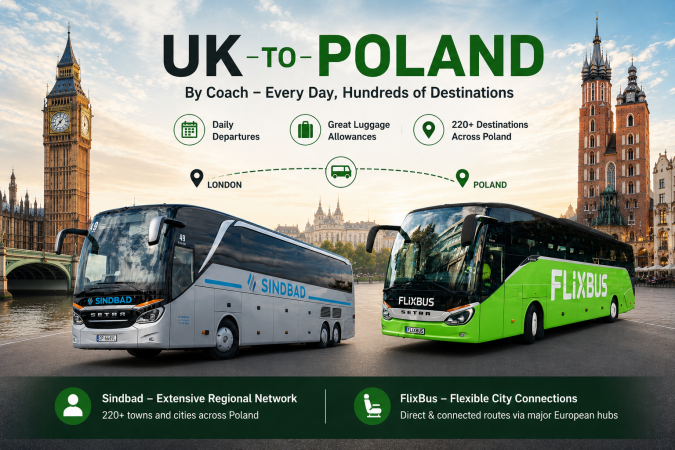
International coach travel between the United Kingdom and Poland remains one of the most important overland transport links in Europe. Despite the growth of low-cost airlines, long-distance coach services continue attracting passengers thanks to direct regional connectivity, generous baggage allowances and access to destinations that are often difficult to reach by air or rail. For many travellers — including families, students, seasonal workers and passengers visiting smaller towns — coaches still provide one of the most practical and affordable ways of travelling between Britain and Poland.
Today, the market is dominated mainly by two different operational models represented by Sindbad and FlixBus. While both operators connect Britain with Poland through extensive European networks, they approach long-distance coach transport in very different ways.
Quick navigation
- Book coach tickets
- Journey times, routes and example coach timetables
- Travelling to London from other parts of the UK
- How coach travel between the UK and Poland works today
- Route schematics
- Sindbad vs FlixBus
- Sindbad transfer hubs
- Coach stations and stops in Poland
- Ticket pricing systems
- Baggage policies
- Seat allocation
- London Victoria Coach Station
- Channel crossing and border controls
- Cities and towns in Poland
- What the journey is really like
- Useful extras before travelling
- Final thoughts
Book coach tickets from the UK to Poland
Use the links below to compare fares, availability and journey options between Britain and Poland. It is worth checking more than one booking system, especially during busy travel periods.
SindbadBest for Sindbad’s coordinated long-distance coach network between the UK and Poland, including regional destinations and integrated transfers. |
FlixBusUseful for direct London–Poland departures on selected days and connecting journeys through the wider European FlixBus network. |
InfobusAlternative international booking platform useful for checking prices, availability and additional coach operators. |
Tip: Before booking, always check luggage rules, transfer details and the exact departure station. Some journeys between the UK and Poland may involve coordinated changes at European coach hubs.
Journey times, routes and example coach timetables
Travel times between Britain and Poland vary depending on traffic conditions, border controls, ferry or tunnel crossings, and whether the journey includes transfers. Most journeys travel overnight through France, Belgium or the Netherlands, and Germany before continuing into Poland.
| Route type | Approximate journey time |
|---|---|
| London → Warsaw / Łódź by dedicated coach service | 26–32 hours |
| London → Southern Poland | 30–38 hours |
| London → Northern Poland | 28–36 hours |
| Connecting journeys via European hubs | Often longer |
Passengers travelling on network-based services should remember that modern European coach travel often works similarly to airline hub systems. Instead of operating one direct coach to every destination, passengers may connect through major hubs before continuing onwards.
Sindbad — London ⇄ Southern Poland
Sindbad operates daily coordinated long-distance services between London and Poland. Southern Poland routes normally run through Dortmund and Port Opole, with onward connections to many regional towns. These aren't all the cities and towns Sindbad serves. They're for informational purposes only.
London ► Southern Poland (Daily service)
- London Victoria Coach Station dep. approx. 07:00
- Dortmund transfer corridor approx. 19:30
- Wrocław arr. approx. 06:15
- Opole arr. approx. 08:05
- Katowice arr. approx. 10:20
- Kraków arr. approx. 08:30
Southern Poland ► London (daily service)
- Kraków dep. approx. 18:30
- Katowice dep. approx. 17:15
- Opole dep. approx. 19:20
- Wrocław dep. approx. 21:10
- Dortmund transfer approx. 20:00
- London Victoria Coach Station arr. approx. 18:30
Sindbad uses coordinated transfer hubs and usually maintains relatively stable nationwide timetables throughout the week.
Sindbad — London ⇄ Northern Poland
Northern Poland routes normally run through Dortmund and Port Świecko before continuing towards western, central and northern Poland. These aren't all the cities and towns Sindbad serves. They're for informational purposes only.
London ► Northern Poland (Daily Service)
- London Victoria Coach Station dep. approx. 07:00
- Dortmund transfer corridor approx. 19:30
- Szczecin arr. approx. 07:00
- Poznań arr. approx. 07:30
- Bydgoszcz arr. approx. 09:00
- Toruń arr. approx.10:15
- Grudziądz arr. approx.10:40
- Olsztyn arr. approx.13:30
- Lodź arr. approx.10:00
- Warszawa arr. approx.12:00
- Gdynia arr. approx. 12:50
- Gdańsk arr. approx. 14:00
- Białystok arr approx. 15:30
Northern Poland ► London (Daily Service)
- Gdańsk dep. approx. 14:00
- Gdynia dep. approx. 14:45
- Białystok dep. approx.12:00
- Warszawa dep. approx. 16:00
- Łódź dep. approx. 18:00
- Olsztyn dep. approx. 14:20
- Grudziądz dep. approx. 17:10
- Toruń dep. approx. 17:50
- Poznań dep. approx. 21:00
- Szczecin dep. approx. 20:20
- Dortmund transfer approx. 20:00
- London Victoria Coach Station arr. approx. 18:30
Many additional towns and regional destinations across Poland are connected through coordinated Sindbad transfers.
FlixBus — London ⇄ Warsaw / Łódź
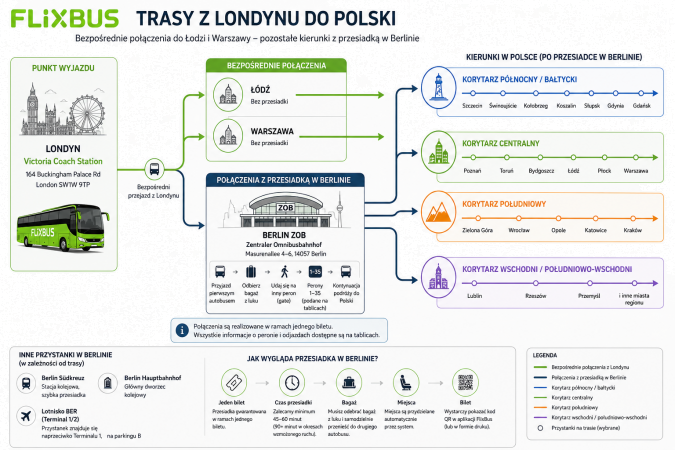
FlixBus operates a dedicated London–Poland service to Warsaw and Łódź on selected days. Other Polish destinations are usually reached by connecting through the wider FlixBus European network.
Dedicated direct-style FlixBus service
London ► Poland
- London Victoria Coach Station dep. approx. 09:30
- Calais / Dover crossing
- Berlin ZOB arr. approx. 05:25
- Łódź Fabryczna arr. approx. 11:45
- Warszawa Zachodnia arr. approx. 13:35
Poland ► London
- Warszawa Zachodnia dep. approx. 15:45
- Łódź Fabryczna dep. approx. 17:35
- Berlin ZOB dep. approx. 23:59
- Calais / Dover crossing
- London Victoria Coach Station arr. approx. 18:10
FlixBus also offers many additional UK–Poland journeys with transfers through Berlin, Warsaw or Łódź. Because FlixBus works as a dynamic European network, connecting services may operate with different departure and arrival times depending on the day, route and seasonal timetable changes.
Travelling to London from other parts of the UK
Although most international services to Poland depart from London Victoria Coach Station, passengers can begin their journey from many other parts of Britain. Domestic coach operators such as National Express, FlixBus and Megabus provide extensive services linking regional cities with London. Passengers travelling from Birmingham, Manchester, Leeds, Liverpool, Bristol, Glasgow, Edinburgh and many other towns can usually connect via domestic coach services before continuing towards Poland.
One advantage of the FlixBus system is that domestic UK routes and international European services can often be booked together within the same reservation. Where synchronised connections exist, the booking system may automatically combine domestic UK services with onward international travel to Poland. This creates a more integrated booking process and reduces the need to arrange separate tickets.
How coach travel between the UK and Poland works today
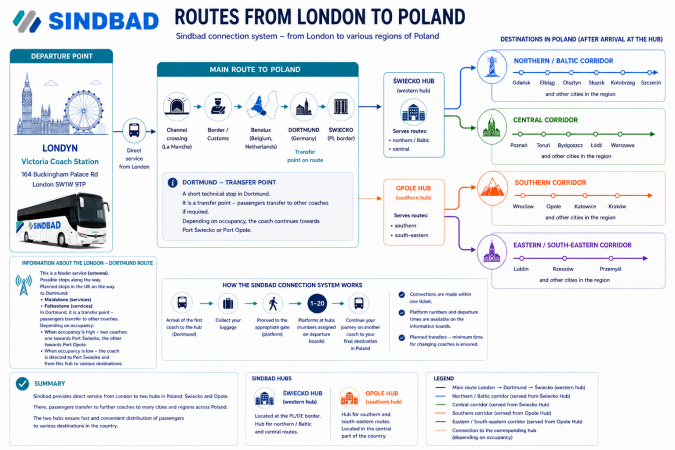
Modern international coach travel no longer operates as a simple fixed route between two cities. Instead, journeys between Britain and Poland increasingly function as interconnected European transport systems built around long-distance corridors, operational hubs, coordinated transfers and network integration. This approach allows operators to serve both major cities and smaller regional destinations across Europe.
Sindbad operational model
Sindbad uses a highly coordinated long-distance corridor system developed specifically for travel between Poland and Western Europe. Passengers departing from London may initially travel on a feeder coach or minibus before joining the main Poland-bound corridor service in cities such as Lille, Brussels or Dortmund. Depending on passenger demand, the feeder section may sometimes be operated by smaller vehicles.
Once inside Poland, the network distributes passengers further through dedicated transfer hubs including Port Świecko and Port Opole. This coordinated structure allows Sindbad to serve more than 220 destinations across Poland, including many towns that remain difficult to access directly by air or rail.
FlixBus network model
FlixBus operates using a large-scale European network model. Some London–Poland services run as dedicated international coach routes on selected days of the week. On other days, journeys may involve coordinated connections through major European hubs such as Lille, Brussels, Eindhoven, Berlin, Warsaw or Łódź.
Berlin plays an especially important role within the FlixBus system, functioning as one of the main interchange points for passengers travelling between Western Europe and Poland. This network-based structure allows FlixBus to offer flexible journey combinations and frequent promotional pricing.
Route schematics
Sindbad operational corridor
FlixBus London–Poland network
Sindbad vs FlixBus — two different philosophies of long-distance coach travel
| Feature | Sindbad | FlixBus |
|---|---|---|
| Operational model | Coordinated long-distance corridors | European network platform |
| Frequency | Daily | Direct service on selected days |
| Main philosophy | Operational coordination and stability | Flexible scalable mobility |
| Transfer hubs | Dedicated hubs: Dortmund / Opole / Świecko | Network-based transfers, mainly via Berlin for many Polish destinations |
| Coverage in Poland | Very extensive regional coverage | Mainly larger cities |
| Smaller towns | Very strong presence | Limited |
| Pricing system | Distance-based pricing | Dynamic pricing |
| Baggage philosophy | Traditional generous allowance | Modular paid options |
| Seat allocation | Operationally managed | Digitally managed |
| Best suited for | Families, luggage, regional travel | Flexible city-to-city travel |
Coordinated transfer hubs — a key difference in the Sindbad network
One of the most distinctive elements of Sindbad’s international operations is its coordinated transfer hub system. Instead of treating transfers as completely separate journeys, Sindbad synchronises long-distance services through dedicated interchange centres including Port Opole and Port Świecko.
These hubs function similarly to airline transfer systems. Incoming and outgoing coaches are coordinated operationally to simplify passenger transfers across Europe.
Passengers may receive:
- transfer platform information
- coach numbers
- boarding instructions
- luggage identification details
- connecting departure times
This significantly reduces uncertainty during long-distance multi-stage journeys. Sindbad’s operational model reflects broader European coach market trends: network integration, operational stability, transfer reliability and coordinated passenger information.
Port Opole and Port Świecko — dedicated coach infrastructure
Unlike simple roadside stops, Sindbad’s hubs function as dedicated interchange facilities for international coach operations.
Facilities may include:
- covered platforms
- waiting areas
- toilets
- information desks
- electronic departure boards
- luggage trolleys
- food points
- vending machines
- parking areas
These hubs are designed to simplify transfers between routes travelling toward Poland, Germany, the United Kingdom, France, Benelux countries and southern Europe. This infrastructure-based approach differs significantly from many low-cost intercity coach models where transfers are often less coordinated.
Coach stations and stop infrastructure in Poland
One of the most overlooked aspects of international coach travel in Poland is the complexity of station infrastructure and boarding locations.
Depending on the city and time of departure:
- arrival and departure stops may differ
- some stations use alternative nighttime stops
- station access may be restricted during holidays or overnight hours
- coaches may depart from nearby streets instead of central terminals
Both Sindbad and FlixBus usually provide detailed stop descriptions, maps and boarding instructions within their booking systems.
Passengers should always verify:
- exact platform location
- nighttime departure points
- alternative stops
- temporary station changes
Ticket pricing systems explained
One of the biggest operational differences between Sindbad and FlixBus is the way ticket prices are calculated.
Sindbad pricing model
Sindbad generally uses a more traditional international coach fare structure based mainly on distance, destination region and route length. In practice, destinations in western Poland are usually cheaper than destinations in eastern Poland because of the longer distance travelled.
Return tickets may be cheaper than buying two separate single tickets, so passengers planning a round trip should compare both options in the booking system before purchasing.
Sindbad fares are usually more predictable than dynamic low-cost platforms, but prices can still change over time and may vary by route, passenger category, promotion and booking channel.
FlixBus pricing model
FlixBus uses dynamic pricing similar to airlines and low-cost rail operators. Ticket prices between the UK and Poland can vary significantly depending on demand, booking date, season, route availability and the number of transfers involved.
The cheapest promotional fares may occasionally start from around £50–£70 one-way, although more typical advance fares are often between £70 and £120. During busy holiday periods or for last-minute bookings, prices may rise to £150–£200+.
Because FlixBus operates as a wider European network rather than a traditional fixed coach line, prices, routes and journey times may vary considerably from day to day. Passengers should always check the live booking system before travelling.
Infobus booking platform
Infobus is an international booking platform rather than one single coach operator. It can be useful for comparing selected services and fares, but passengers should always check which operator actually runs the journey, what baggage rules apply and whether transfers are included in one booking.
Baggage policies — traditional vs modular systems
Sindbad baggage policy
Sindbad generally follows a simpler and more traditional baggage model. Passengers usually receive approximately 30 kg checked baggage allowance and one hand luggage item, with fewer baggage categories and less fragmented upselling. This approach remains particularly attractive for families, seasonal workers, long-term travellers and passengers relocating between countries.
FlixBus baggage policy
FlixBus uses a more modular baggage structure. Passengers may encounter separate categories for additional baggage, oversized baggage, bicycles, musical instruments, prams and special luggage. Standard tickets usually include one main suitcase and hand luggage. Additional services may require separate payment depending on route availability.
Seat allocation policies — Sindbad vs FlixBus
For many passengers travelling between London and Poland, seating arrangements become particularly important on journeys lasting over 24 hours.
| Feature | Sindbad | FlixBus |
|---|---|---|
| Standard seat assignment | Usually assigned during boarding | Automatically assigned during booking |
| Seat management | Driver or steward coordination | Digital reservation system |
| Paid seat selection | Limited / route dependent | Commonly available |
| Extra empty seat option | Available on selected routes | Available for an additional fee |
| High-season restrictions | Possible | Possible |
Sindbad seat allocation system
Sindbad generally uses a more operational boarding model. Seats are often assigned during boarding by the driver or by the onboard steward. This allows the crew to optimise occupancy, coordinate family seating, manage transfers and organise passenger distribution more efficiently.
FlixBus seat selection system
FlixBus uses a more airline-style digital reservation model. Passengers may receive automatically assigned seats or choose specific seats during booking for an additional fee. Optional upgrades may include front-row seats, panoramic seats, table seating, window seats and neighbouring empty seats.
London Victoria Coach Station, documents and check-in
Most international coach services between Britain and Poland depart from London Victoria Coach Station, the main long-distance coach terminal in the UK. It is separate from the nearby Victoria railway and Underground stations, so passengers should allow enough time to reach the correct building.
Before leaving home, make sure you have packed all essential documents and items required for the journey, especially your passport, ticket or booking confirmation, visa or transit documents if required, travel insurance details and any medical certificates or prescription medication you may need during the trip.
Passengers travelling on international services should usually arrive at least 30–60 minutes before departure. Passengers should check the station screens and operator instructions on the day of travel.
Have your passport and ticket ready before approaching check-in or boarding staff. Luggage should be clearly labelled with your name and contact details, and passengers should never carry parcels or bags belonging to another person.
International coach journeys involve border controls and customs procedures. Passengers may be asked to leave the coach, present documents, open luggage or pass through security screening during the journey.
Victoria Coach Station offers departure gates, waiting areas, cafés, toilets, ticket offices and luggage services. Coaches arriving from Europe may use the Arrivals terminal, while onward domestic coach departures usually leave from the Departures terminal across the road.
Ferry crossings, Eurotunnel and border controls
International coach services between Britain and mainland Europe normally use either ferry crossings or the Eurotunnel shuttle. Sindbad services generally use the Eurotunnel route between Folkestone and Calais, although ferry crossings may occasionally be used for operational reasons. The dedicated FlixBus service to Poland usually uses ferry crossings. Since Brexit, passengers should also expect UK exit procedures, French immigration checks, customs controls and possible delays during busy travel periods.
| Channel ferry crossing ▶▶▶ | Watch video | Channel tunnel crossing ▶▶▶ | Watch video |
|---|
Cities and towns in Poland reachable from the UK by coach
Sindbad and FlixBus connect London with many destinations across Poland. Sindbad’s network is particularly strong for regional towns and smaller destinations served through coordinated transfers.
| Letter | Cities and towns in Poland |
|---|---|
| A | Andrychów, Augustów |
| B | Bełchatów, Białystok, Biecz, Bielsko-Biała, Biłgoraj, Biskupiec, Bochnia, Bolesławiec, Brodnica, Brzeg, Brzesko, Busko-Zdrój, Bydgoszcz, Bytom |
| C | Chełm, Chojnice, Chorzów, Ciechanów, Cieszyn, Czersk, Częstochowa, Człuchów |
| D | Dębica, Dobrodzień, Dzierżoniów |
| E | Elbląg, Ełk |
| G | Gdańsk, Gdynia, Giżycko, Gliwice, Głogów, Głogówek, Głubczyce, Głuchołazy, Gniezno, Gorlice, Gorzów Śląski, Gorzów Wielkopolski, Grodków, Grudziądz, Grybów |
| I | Iława, Inowrocław |
| J | Janów Lubelski, Jarocin, Jarosław, Jasło, Jastrowie, Jastrzębie Zdrój, Jawor, Jelenia Góra, Jędrzejów |
| K | Kalisz, Katowice, Kędzierzyn-Koźle, Kępno, Kętrzyn, Kęty, Kielce, Kluczbork, Kłodzko, Kolbuszowa, Kołobrzeg, Konin, Koszalin, Kraków, Krapkowice, Kraśnik, Krosno, Krosno Odrzańskie, Krotoszyn, Kwidzyn |
| L | Legnica, Leszno, Leżajsk, Lębork, Limanowa, Lubaczów, Lubin, Lublin, Lubliniec |
| Ł | Łomża, Łódź |
| M | Malbork, Mielec, Międzyzdroje, Milicz, Mrągowo, Mszana Dolna, Myślenice |
| N | Narol, Nisko, Nowa Sarzyna, Nowa Sól, Nowe Miasto Lubawskie, Nowogard, Nowy Sącz, Nysa |
| O | Okmiany, Olesno, Oleśnica, Olsztyn, Oława, Opole, Orzysz, Ostrołęka, Ostrowiec Świętokrzyski, Ostróda, Ostrów Wielkopolski, Ostrzeszów, Oświęcim, Ozimek |
| P | Piła, Piotrków Trybunalski, Płock, Podgaje, Polkowice, Poznań, Praszka, Prudnik, Przemyśl, Przeworsk, Pszczyna, Pszów, Puławy, Pyskowice |
| R | Racibórz, Radom, Radomsko, Ropczyce, Rybnik, Rzeszów |
| S | Sandomierz, Sanok, Sieradz, Skarżysko-Kamienna, Skoczów, Sławno, Słubice, Słupsk, Stalowa Wola, Starachowice, Starogard Gdański, Staszów, Strzegom, Strzelce Opolskie, Suwałki, Syców, Szczecin, Szczekociny, Świdnica, Świebodzin, Świecie, Świnoujście |
| T | Tarnobrzeg, Tarnów, Tczew, Tomaszów Lubelski, Toruń, Toszek, Trzebnica, Tychy |
| W | Wadowice, Wałbrzych, Wałcz, Warszawa, Wejherowo, Wieluń, Włocławek, Wodzisław Śląski, Wrocław, Wschowa |
| Z | Zabrze, Zamość, Zawiercie, Ząbkowice Śląskie, Zduńska Wola, Zgorzelec, Zielona Góra |
| Ż | Żnin, Żory, Żywiec |
What long-distance coach travel between the UK and Poland is really like
Travelling between London and Poland by coach is a genuine overland European journey rather than a short airport transfer.
Passengers should expect:
- overnight travel
- long motorway sections
- regular refreshment stops
- changing weather conditions
- border procedures
- multiple countries within one journey
Modern coaches are usually equipped with reclining seats, toilets, charging sockets, air-conditioning and Wi-Fi, although availability varies by route and operator.
Although the journey is long, many passengers continue choosing coaches because of direct access to regional towns, simpler luggage policies, fewer airport formalities and coordinated long-distance travel across Europe.
Useful extras before travelling
- travel insurance
- hotel accommodation
- currency exchange
- prepaid travel cards
- car rental after arrival in Poland
AFFILIATE LINK — HOTEL BOOKING
AFFILIATE LINK — TRAVEL INSURANCE
AFFILIATE LINK — CAR RENTAL
AFFILIATE LINK — CURRENCY / TRAVEL MONEY
Final thoughts
The UK–Poland corridor remains one of the most important international coach markets in Europe. Sindbad and FlixBus continue expanding their presence across the continent, but they do so using fundamentally different operational philosophies. Sindbad focuses primarily on operational coordination, integrated transfer systems and stable long-distance connectivity. FlixBus focuses more heavily on scalable digital mobility, dynamic pricing and flexible online management.
For passengers travelling between Britain and Poland, the choice often depends on whether they prioritise operational predictability, baggage simplicity and coordinated transfers, or promotional pricing, digital flexibility and app-based journey management.
For many travellers, long-distance coach services still remain one of the most practical and regionally connected ways of travelling between the UK and Poland.