Travelling from the UK to Norway by Bus
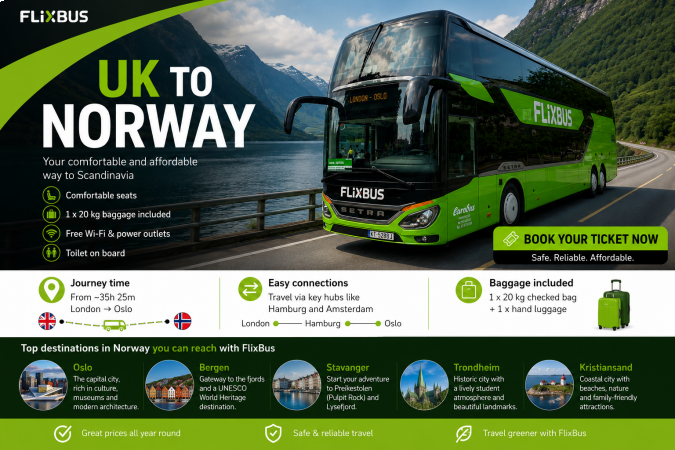
Travelling from the United Kingdom to Norway by coach is very different from travelling to mainland Central Europe. Unlike routes to Poland, the Czech Republic or Germany, long-distance coach travel to Norway is not built around one dominant direct corridor with large central bus stations every few hundred kilometres. Modern Scandinavian coach travel works in a different way. Most journeys between Britain and Norway involve several stages across multiple countries, with transfers commonly taking place in Germany, Denmark or Sweden before continuing north into Norway. For many passengers this can initially seem more complicated than travelling elsewhere in Europe, but it reflects the geography and transport structure of Scandinavia itself.
At the same time, coach travel still remains relevant despite the popularity of flights between Britain and Norway. Some passengers prefer the lower overall cost, particularly during peak travel periods when Scandinavian air fares can rise sharply. Others value the larger baggage allowances, especially for long stays, seasonal work or extended travel. Overland journeys can also provide access to regional destinations that may otherwise require additional domestic flights or expensive rail connections. Unlike airport-based travel, long-distance coach networks in Scandinavia often connect a wide range of smaller towns, regional transport hubs and roadside interchange points across southern Norway.
Check FlixBus tickets to Norway
Quick navigation
- How FlixBus travel to Norway works today
- London Victoria Coach Station
- Travelling from outside London
- Example fastest coach connection: London to Oslo
- Example return journey: Oslo to London
- Typical journey times
- Ticket prices and booking advice
- Scandinavian interchange infrastructure
- Borders, Schengen and travel documents
- Baggage and long-distance travel realities
- Comfort onboard
- FAQ
- Final thoughts
How FlixBus travel to Norway works today
Modern FlixBus travel between Britain and Norway is usually based around integrated European coach corridors rather than traditional direct international coach lines. In practice, this means passengers often travel through several different operational stages:
- UK domestic feeder routes,
- Channel crossing corridors,
- mainland European long-distance services,
- Scandinavian interchange hubs,
- regional Nordic coach connections.
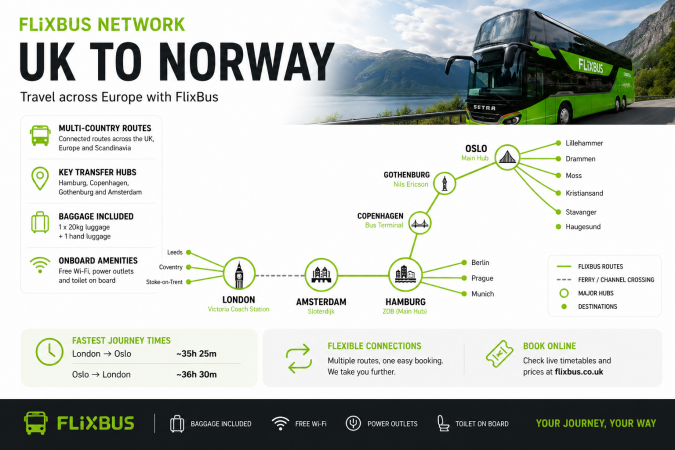
A typical journey may begin with a domestic connection into London Victoria Coach Station before continuing through mainland Europe towards Germany. From there, passengers are commonly routed towards Denmark and southern Sweden before entering Norway through the Oslo corridor. Unlike older coach systems, modern FlixBus routing is highly flexible. The exact interchange city may vary depending on season, traffic, operational demand, network availability and timetable changes. Passengers should therefore always check the live booking system before travelling. One of the biggest differences passengers notice in Scandinavia is the infrastructure itself. In Germany or Poland, long-distance coaches often use large central bus stations. In Norway, however, many services rely on a mixture of regional transport terminals, motorway interchange points, roadside pickup locations, park-and-ride style stops and corridor-based transport hubs. This reflects the geography of Norway, where long distances, mountain terrain and dispersed population centres shape the transport network differently from continental Europe.
Search FlixBus UK to Norway routes
London Victoria Coach Station
Most long-distance coach journeys from London to Norway start at London Victoria Coach Station, the main international and domestic coach terminal in the capital. It should not be confused with Victoria railway station, which is nearby but located in a separate building. For passengers travelling to Norway, Victoria Coach Station is important because it brings together UK domestic coach services, international FlixBus departures and onward connections towards mainland Europe. This makes it the natural starting point for most overland journeys from Britain to Scandinavia.
Passengers should arrive early, especially for international departures. Long-distance coaches may begin boarding before the advertised departure time, and passengers will usually need enough time to find the correct gate, check the departure screens, store luggage and board calmly.
Victoria Coach Station has basic passenger facilities including waiting areas, toilets, ticket offices, food outlets and nearby shops. However, it can become busy at peak times, especially in the evening when many overnight coaches depart for Europe.
For a journey as long as London to Oslo, passengers should check the departure gate carefully and keep the ticket available throughout the boarding process. The exact coach bay can change, so the information displayed at the station should always be followed on the day of travel.
Travelling from outside London
Passengers starting outside London will usually need to reach London Victoria Coach Station before joining the international FlixBus journey towards Norway. This is an important part of the trip and should be planned carefully, especially because the onward journey to Oslo is long and usually time-sensitive.
London can be reached by coach or train from most major UK cities, including Birmingham, Manchester, Liverpool, Leeds, Bristol, Cardiff, Nottingham, Newcastle, Glasgow and Edinburgh. National Express, FlixBus, Megabus and rail services may all be relevant depending on the departure city.
If the UK domestic journey and the international FlixBus journey are booked separately, passengers should allow a generous buffer in London. A delay on a separate domestic ticket may not protect the onward international booking.
For this reason, passengers travelling from outside London should avoid very tight same-day connections. Where possible, it is better to arrive in London several hours before departure. For very long journeys to Norway, some passengers may prefer to travel to London the day before, especially if starting from Scotland, northern England, Wales or the South West.
Passengers arriving by train should also remember that Victoria Coach Station is not inside Victoria railway station. The walk between the two usually takes several minutes, and extra time should be allowed when carrying luggage.
Example fastest coach connection: London → Oslo
The quickest currently available coach journeys between Britain and Norway are normally built around a fast overnight connection from London to Hamburg, followed by a same-day Scandinavian service onwards to Oslo. Rather than multiple complicated changes, the fastest itineraries usually involve just one transfer in Hamburg, making the journey surprisingly straightforward for such a long-distance overland route.
Day 1 — Depart London
- Depart: London Victoria Coach Station — 20:30
- Overnight coach via Dover, Belgium, the Netherlands and northern Germany
- Arrive: Hamburg ZOB — 15:35 next day
The London–Hamburg section forms the backbone of the journey and is one of the most important long-distance international corridors within the FlixBus network. Coaches typically operate through the night and continue deep into continental Europe without passengers needing to change vehicles.
Transfer in Hamburg
- Transfer time: approximately 2 hours 25 minutes
Hamburg acts as the principal interchange point between mainland Europe and Scandinavia. Most northbound services towards Denmark, Sweden and Norway connect here. The relatively generous transfer time is important because motorway traffic, ferry operations and border-related delays across several countries can occasionally affect punctuality.
Day 2 — Hamburg → Oslo
- Depart: Hamburg ZOB — 18:00
- Overnight Scandinavian corridor service
- Arrive: Oslo — 08:55 following morning
This section usually operates through Denmark, the Øresund corridor, southern Sweden and onwards into Norway. Typical Scandinavian corridor points along the wider network may include locations such as Landskrona, Moss, Sarpsborg, Grimstad and Kristiansand area interchange points. The Scandinavian part of the journey feels noticeably different from mainland Europe, with longer motorway sections, fewer urban stops and more regional interchange infrastructure.
Check London to Oslo coach fares
Example return journey: Oslo → London
Southbound journeys from Norway back to Britain generally follow the reverse Scandinavian corridor through Sweden, Denmark and northern Germany before continuing west towards the Netherlands, Belgium and the Channel crossing.
Unlike the northbound route, return journeys sometimes involve an additional change in Amsterdam depending on the operational timetable on the day of travel.
Day 1 — Depart Oslo
- Depart: Oslo — 21:40
- Overnight Scandinavian corridor service
- Arrive: Hamburg ZOB — 12:05 next day
This overnight section typically travels south through Sweden and Denmark before continuing into Germany. As with northbound services, weather and motorway conditions across Scandinavia can influence arrival times, particularly during winter months.
Transfer in Hamburg
- Transfer time: approximately 1 hour 25 minutes
Passengers then continue westbound towards the Netherlands.
Hamburg → Amsterdam
- Depart: Hamburg ZOB — 13:30
- Arrive: Amsterdam Sloterdijk — 20:10
Amsterdam Sloterdijk is one of the key western European interchange points within the FlixBus network and frequently acts as a transfer hub for UK-bound services.
Transfer in Amsterdam
- Transfer time: approximately 2 hours 20 minutes
Passengers then board the overnight UK-bound coach service towards London.
Day 2 — Amsterdam → London
- Depart: Amsterdam Sloterdijk — 22:30
- Overnight journey via ferry or Channel crossing
- Arrive: London Victoria Coach Station — 09:10 following morning
The final section includes the crossing back to Britain before continuing towards central London.
Typical journey times
Using the fastest currently available coach connections:
- London → Oslo: approximately 35 hours 25 minutes
- Oslo → London: approximately 36 hours 30 minutes
Journeys further into Norway towards cities such as Stavanger or Kristiansand will normally require additional regional connections. Overall journey times may vary depending on traffic, weather, motorway conditions, interchange duration and seasonal timetable changes. Winter conditions across Scandinavia can occasionally affect long-distance coach operations, particularly on overnight sections through Sweden and Norway.
Ticket prices and booking advice
One of the main reasons passengers still consider long-distance coach travel to Norway is pricing. Flights between Britain and Scandinavia can often become expensive during summer holidays, Christmas, weekends, last-minute bookings and peak seasonal periods.
By comparison, FlixBus fares can sometimes remain relatively competitive, particularly for passengers booking well in advance or travelling outside peak dates.
Current FlixBus pricing shows:
- London → Oslo journeys starting from around £80–£120
However, prices can vary significantly depending on season, day of travel, availability, school holidays, booking lead time and Scandinavian demand levels. The cheapest fares are usually available midweek, outside holiday periods and several weeks in advance. Last-minute Scandinavian bookings can become considerably more expensive, especially during summer and Christmas travel periods.
Passengers travelling between Britain and Norway should also avoid focusing purely on the cheapest headline fare. A slightly more expensive itinerary may sometimes offer fewer transfers, longer interchange times, lower risk of missed connections, simpler overnight routing and better overall journey comfort. For example, the London → Hamburg → Oslo itinerary described above is operationally much simpler than routes involving multiple short transfer windows across several countries. Whenever possible, passengers should ideally book the entire journey under one integrated FlixBus reservation. This is particularly important on Scandinavian routes where weather, motorway traffic, ferry operations and overnight corridor services can occasionally affect punctuality. Separate self-booked tickets may appear cheaper initially, but they can increase the risk of missed transfers, loss of onward reservations, additional accommodation costs and expensive last-minute rebooking.
Standard long-distance FlixBus fares between Britain and Norway usually include:
- one checked bag up to 20 kg,
- one item of hand luggage,
- onboard Wi-Fi,
- charging sockets,
- onboard toilet facilities.
For many passengers, baggage inclusion remains one of the biggest advantages of coach travel compared with low-cost airlines serving Scandinavia.
Scandinavian interchange infrastructure
One of the most interesting aspects of coach travel in Norway is how different the infrastructure feels compared with much of mainland Europe. In many Central European countries, passengers are used to large central bus stations with dozens of departure stands. Norway often works differently. Long-distance coaches may instead use:
- regional transport terminals,
- motorway interchange points,
- roadside pickup areas,
- integrated rail and coach hubs,
- shopping-centre transport interchanges,
- park-and-ride facilities.
For passengers unfamiliar with Scandinavian transport, some stops may appear surprisingly simple. This does not necessarily mean the service is unofficial or temporary. In Norway especially, transport infrastructure is often designed around practical road access rather than large station buildings.
Passengers should always check:
- the exact stop location,
- platform information,
- GPS coordinates where provided,
- departure instructions shown on the ticket.
Arrival and departure points may differ even within the same town.
Borders, Schengen and travel documents
Passengers travelling from the UK to Norway by coach normally pass through several countries before reaching Norway itself. Although Norway is not part of the European Union, it is part of the Schengen Area. This means border procedures can differ from those encountered when travelling elsewhere in Europe.
Passengers should always carry:
- a valid passport,
- any required visas or residence permits,
- travel insurance documentation,
- booking confirmations,
- proof of onward travel where necessary.
Requirements may differ depending on nationality.
Passengers should always verify the latest government travel advice and immigration requirements before departure.
Baggage and long-distance travel realities
One reason some passengers still prefer coach travel to Norway is baggage flexibility. This can be particularly useful for seasonal workers, students, long-stay travellers and passengers carrying winter clothing or additional luggage. However, long-distance coach travel to Scandinavia should also be approached realistically. Passengers may spend multiple nights travelling, extended periods on motorways, long transfer intervals in interchange hubs and significant time seated onboard. Winter weather can also affect motorway speeds, regional connections, arrival times and transfer reliability. Passengers travelling during colder months should prepare carefully.
Useful items for long-distance Scandinavian coach journeys include:
- power bank,
- waterproof outer layer,
- snacks,
- travel pillow,
- medicines,
- charging cables,
- headphones,
- warm clothing,
- printed booking information.
Passengers should also label all checked baggage clearly, particularly on journeys involving multiple transfers.
Comfort onboard
Modern long-distance FlixBus coaches usually include reclining seats, onboard toilets, charging sockets, Wi-Fi, overhead luggage racks and air conditioning or heating. However, standards can vary depending on the operating partner and route. Passengers should approach multi-day coach travel with realistic expectations. Sleep quality onboard is usually limited, especially during overnight motorway sections and interchange stops. Refreshment breaks are normally provided during longer journeys, although the frequency and duration may vary depending on local driving regulations and operational conditions. Travelling with children or elderly passengers may require additional planning due to the length of Scandinavian overland journeys.
FAQ: UK to Norway by FlixBus
Is there a direct coach from London to Norway?
Direct UK–Norway coach services are not normally the standard way this journey works today. The fastest practical FlixBus itineraries usually involve travelling from London to Hamburg and then changing onto a Scandinavian service towards Oslo.
How long does the coach from London to Oslo take?
The fastest currently available London to Oslo coach itineraries take around 35 hours, although journey times can vary depending on traffic, transfer times, weather and seasonal timetable changes.
Where do passengers usually change coaches?
Hamburg is one of the most important interchange points for UK to Norway coach travel. Some return journeys may also involve a change in Amsterdam before continuing to London.
Is FlixBus to Norway cheaper than flying?
It can be cheaper, especially when booked in advance or outside peak travel periods. However, prices vary dynamically, and flights may sometimes be competitive. Coach travel is often most attractive for passengers who value baggage allowance, overland travel or regional access.
How much does London to Oslo by FlixBus cost?
London to Oslo fares can start from around £80–£120, but prices change depending on date, demand, availability and booking time. Passengers should always check the live FlixBus booking system before travelling.
Is one ticket better than separate tickets?
For long-distance journeys to Norway, an integrated FlixBus booking is usually safer than separate self-booked tickets. Separate tickets may look cheaper but can create problems if one section is delayed and the onward coach is missed.
Does the journey include a ferry or Channel crossing?
The UK to mainland Europe section normally involves a Channel crossing. The exact operational method may depend on the service and timetable. Passengers should follow the instructions shown on their ticket and by the driver.
What luggage is normally included?
Standard FlixBus tickets usually include one item of hand luggage and one checked bag, but passengers should always check the current baggage rules before booking, especially if carrying extra luggage, sports equipment or winter gear.
Is the journey suitable for children or elderly passengers?
The journey is possible, but it is long and tiring. Passengers travelling with children, elderly relatives or anyone with reduced mobility should consider the length of the trip, overnight sections, transfer times and access to station facilities.
Should I check the live timetable before travelling?
Yes. Routes, departure times, transfer points and fares can change. Passengers should always check the live FlixBus booking system before departure.
Final thoughts
Travelling from the UK to Norway by coach is no longer based around the traditional concept of a single direct international line. Today’s Scandinavian FlixBus network instead operates through a flexible system of long-distance corridors, transfer hubs, regional feeder routes and coordinated European connections. Understanding this structure helps passengers plan more realistic and less stressful journeys. Passengers expecting a simple point-to-point coach service may initially find Scandinavian coach travel surprisingly different from mainland Europe. However, for travellers who understand how the system works, coach travel can still provide a practical and relatively affordable overland route between Britain and Norway. Most importantly, passengers should always check the live booking system before departure, as routes, transfers and schedules can change regularly throughout the year.